
Dickery, Dickery, Dare
Lyrics
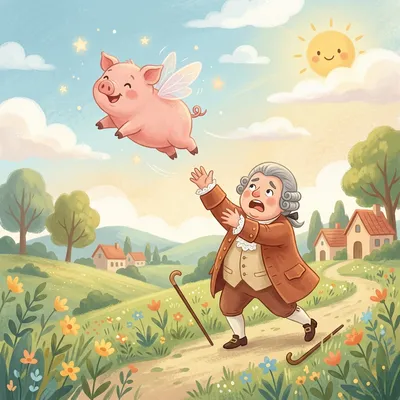
Dickery, dickery, dare,The pig flew up in the air;The man in brown soon brought him down,Dickery, dickery, dare.
History and Meaning
Four lines, one pig, no explanation. "Dickery, Dickery, Dare" launches a pig into the sky, sends a man in brown to bring it back down, and then stops. There is no moral, no warning, and no buried history to dig out. The rhyme exists for its beat and for the absurd picture it puts in a child's head.
That is worth saying at the start, because plenty of nursery rhymes have collected elaborate historical readings over the years and this one has collected almost none. It is a small joke made of strong rhythm and an impossible image, and it sits right next to Hickory Dickory Dock, which shares its opening formula, its meter, and usually its tune.
Origins
The printed record for this particular quatrain is thin. It appears in The Real Mother Goose, the 1916 American collection illustrated by Blanche Fisher Wright, and in Walter Jerrold's The Big Book of Nursery Rhymes from around 1920, illustrated by Charles Robinson. Those are printings, not origins. No specific first appearance in print has been established for it, and no country of origin can be documented with confidence either, so any firm date attached to it elsewhere should be treated with suspicion unless a source names the book and the year.
Its older sibling is far better documented. "Hickory Dickory Dock" was printed in Tommy Thumb's Pretty Song Book in London in 1744, where the opening line reads "Hickere, Dickere Dock". The next known version, in Mother Goose's Melody around 1765, prints it as "Dickery, Dickery Dock". So the "dickery" form of the opening was already circulating for the clock rhyme in the eighteenth century, well before anyone wrote down a pig going up in the air. Whether "Dare" grew out of "Dock" as a deliberate parody, or whether both drew on a shared stock of nonsense syllables, is not something the printed record settles.
What can be said is that "hickory dickory" and "dickery dickery" belong to a broad family of nonsense openings used in counting-out games and rhythm chants. Iona and Peter Opie noted that "hickory dickory dock" itself worked as a counting formula. Sequences like that survive because they are easy to say fast and land the stresses in the same place every time, which keeps them useful for picking who is "it" long after the words stop meaning anything.
Meaning & Interpretation
There is no documented meaning here, and no serious folklorist has claimed one. Attempts to tie the rhyme to a historical figure or event have nothing behind them.
What it has instead is a joke everyone gets immediately. A flying pig is the standard English shorthand for something that cannot happen, so the second line is funny before you reach the third. Then comes the deflation. An ordinary man, described only by the colour of his coat, calmly brings the pig down again. The impossible thing happens, someone deals with it, and the rhyme closes by repeating its own first line. Nothing has changed. That circular shape, out and back with no consequences, is part of why it is safe to laugh at.
What does Dickery, Dickery, Dare mean?
Nothing. "Dickery, dickery, dare" is a nonsense phrase picked for its rhythm and for the way it rhymes with "air", not for any sense the words carry. The rest of the rhyme is one absurd image, a pig flying up and being fetched back down, with no lesson and no hidden reference. Some rhymes reward digging. This one does not, and saying so is more honest than inventing an interpretation for it.
Is Dickery, Dickery, Dare the same rhyme as Hickory Dickory Dock?
No, they are separate rhymes, but they are close relatives. Both open with a three-word nonsense formula, both run to four short lines, both end by repeating the opening line, and both are commonly sung to the same tune. "Hickory Dickory Dock" is much older in print, first recorded in 1744, and it was printed as "Dickery, Dickery Dock" in the 1760s, which shows how loosely those opening syllables floated. "Dare" is often taught straight after "Dock" for exactly that reason, and a child who knows one picks up the other in about a minute.
Who is the man in brown?
He is nobody in particular. The rhyme identifies him only by his brown coat, which exists to rhyme with "down". No source connects him to a real person, a trade, or a story, and he does nothing except restore order in half a line.
Why do very young children enjoy rhymes like this?
Strong rhythm plus a clear absurd image is close to ideal for a toddler. The beat is regular enough to clap or bounce to, which is how most children first meet it, and repeating the first line as the last line gives the whole thing a shape a two-year-old can hold in mind. The humour lands at that age too. A child has to know that pigs stay on the ground before a flying one is funny, so the joke quietly confirms something they have only just worked out.
Related Nursery Rhymes




Lyrics from nurseryrhymes.info