

Hickory Dickory Dock


Lyrics
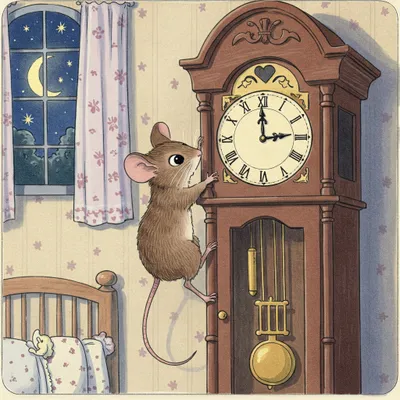
Hickory dickory dockThe mouse ran up the clockThe clock struck oneThe mouse ran downHickory dickory dock.
Hickory dickory dockThe mouse ran up the clockThe clock struck twoThe mouse went "boo!"Hickory dickory dock.
Hickory dickory dockThe mouse ran up the clockThe clock struck threeThe mouse went "weeee!"Hickory dickory dock.
Hickory dickory dockThe mouse ran up the clockThe clock struck fourThe mouse went "no more!"Hickory dickory dock.
History and Meaning
A mouse runs up the clock, the clock strikes one, and the mouse bolts back down. "Hickory Dickory Dock" is barely a story, but its tick-tock rhythm has kept it in nurseries for nearly three centuries, and its three nonsense opening words have drawn some surprisingly serious theories.
Origins
The song is cataloged as number 6489 in the Roud Folk Song Index. It was first published around 1744 in London, appearing in the early compilation Tommy Thumb's Pretty Song Book. The original printed version featured slightly different spelling, beginning with the line "Hickere, Dickere, Dock." The simple narrative of a mouse running up a clock and running down when it strikes one has remained popular for nearly three centuries.
Meaning & Interpretation
The primary purpose of the rhyme is educational and rhythmic, mimicking the ticking of a grandfather clock. The words "hickory," "dickory," and "dock" are onomatopoeic, reflecting the sound of a pendulum swinging back and forth.
Folklorists and historians have proposed several theories regarding the origin of the opening words. The most popular theory is that the phrase comes from Cumbric, an extinct Celtic language spoken by shepherds in northern England who used terms like "hevera," "devera," and "dick" to count sheep.
Another popular legend associates the rhyme with the fifteenth-century astronomical clock at Exeter Cathedral in Devon, England. The clock was lubricated with animal fat, which attracted mice. The cathedral door had a small hole cut in it, which allowed cats to enter and hunt the rodents running up the clockworks. A third theory suggests the song is a political satire mocking Richard Cromwell, who briefly succeeded his father Oliver Cromwell in 1658, comparing his quick rise and fall to the mouse running up and down the clock.
What is the origin of Hickory Dickory Dock?
The rhyme was first published in London in 1744 in Tommy Thumb's Pretty Song Book. It has roots in English folklore and shepherd counting systems from northern England.
What does the phrase hickory dickory dock mean?
The phrase is likely onomatopoeic, designed to sound like the ticking of a clock. It may also derive from Cumbric sheep-counting numbers used by northern shepherds.
Music Video
If the player is unavailable, watch this video on YouTube.
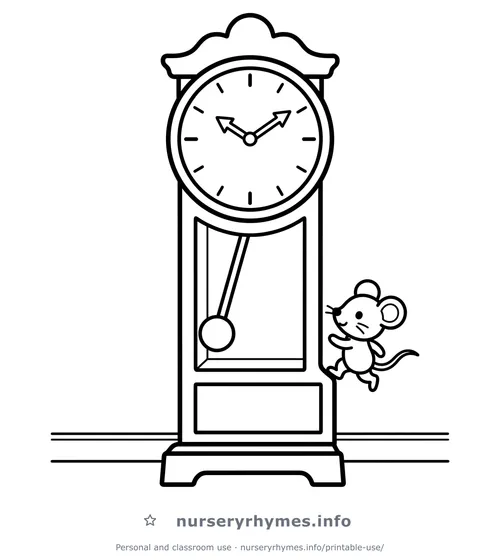
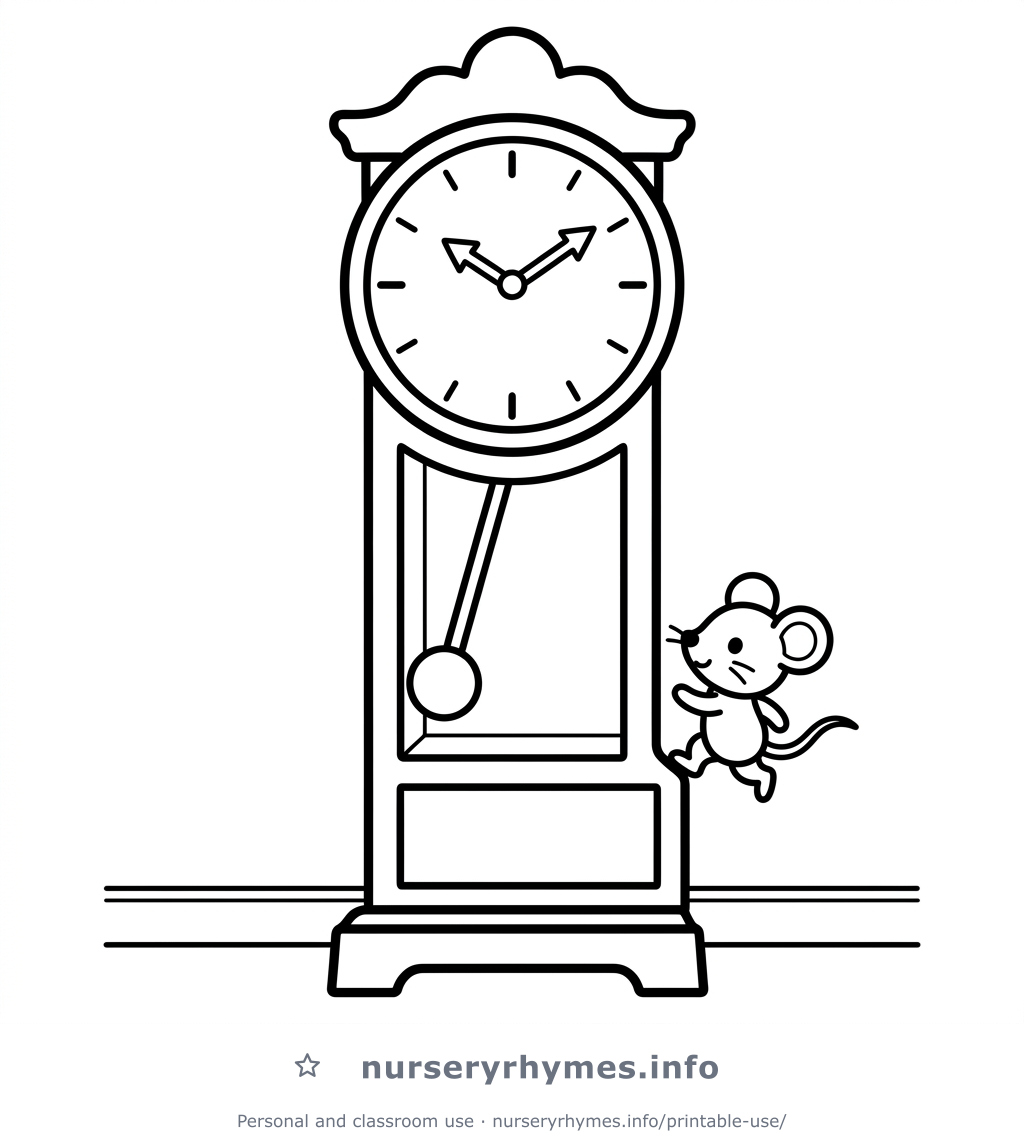
Free Printable Coloring Page
Print this Hickory Dickory Dock coloring sheet for free and let little ones bring it to life with crayons or pencils.
Full-resolution PNG · Fits the paper size selected in your print dialog · Personal and classroom use
Related Nursery Rhymes






Lyrics from nurseryrhymes.info