

Angels We Have Heard on High


Lyrics
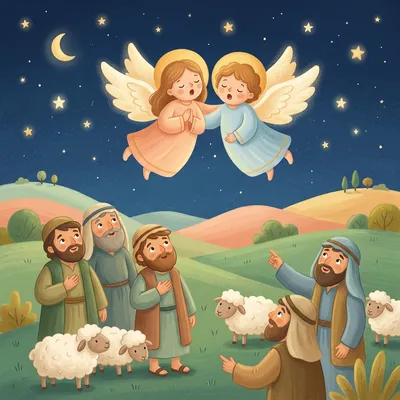
Angels we have heard on highSweetly singing o'er the plains,And the mountains in replyEchoing their joyous strains.
Chorus
Gloria, in excelsis Deo!Gloria, in excelsis Deo!
Shepherds, why this jubilee?Why your joyous strains prolong?What the gladsome tidings beWhich inspire your heavenly song?
History and Meaning
One word in this carol takes longer to sing than most whole lines. In the familiar arrangement, the "o" in "Gloria" is held across sixteen notes that climb and fall before the singers finally arrive at "in excelsis Deo". Musicians call that a melisma: one syllable stretched over many notes instead of the usual one note per syllable. It is the reason people recognise this carol from its first three seconds, and the reason children love singing it.
The song began in French as "Les Anges dans nos campagnes", which means "the angels in our countryside". The English words most of the world sings are not a line-by-line translation of that French carol but a free rendering of it, written by an English bishop in the 1860s.
Origins
The French carol is traditional and its author is unknown. The earliest known printing of "Les Anges dans nos campagnes" with both words and music appeared in 1842, in a collection called Choix de cantiques sur des airs nouveaux published in Quebec. The song itself is older than that printing and is usually traced to southern France, where it also circulated under the title "L'écho des montagnes de Bethléem", the echo of the mountains of Bethlehem.
The English version comes from James Chadwick (1813-1882), an Anglo-Irish Catholic priest who later became Bishop of Hexham and Newcastle. His text appeared in Holy Family Hymns around 1860 and then in Crown of Jesus, a Catholic devotional manual published in London in 1862, filed under the heading "The Twelve Mysteries of the Sacred Infancy" and simply called "Christmas Hymn". Chadwick paraphrased rather than translated. He kept the shepherds, the mountains and the Latin refrain, but the English lines are his own invention, and later editors adjusted his wording again to smooth out the metre.
The tune most hymnals print is called "Gloria". Edward Shippen Barnes harmonised it for the New Church Hymnal in 1937, building on an earlier setting by Charles Hutchins from 1891. Hutchins had used only one "Gloria" in the refrain; Barnes filled out the pair that congregations sing now.
Meaning & Interpretation
The carol retells Luke 2, in which angels appear to shepherds watching their flocks at night and announce the birth of Jesus. The point of view is unusual for a Christmas carol. The first verse is sung by people who heard the angels, and the second verse is a direct question put to the shepherds themselves: why the celebration, and what news could possibly be worth a song like that?
There is a long-standing French tradition, often repeated but not documented in early sources, that shepherds in the hills of southern France called "Gloria in excelsis Deo" to one another across the valleys on Christmas Eve, each hillside answering the next. Whether or not that custom produced the carol, it matches what the music actually does. The line "and the mountains in reply echoing their joyous strains" describes an echo, and the long rolling refrain sounds like one.
What does Gloria in excelsis Deo mean?
It is Latin for "Glory to God in the highest". The phrase is taken from the angels' announcement to the shepherds in Luke 2:14, and it is also the opening line of a very old church hymn known as the Greater Doxology, which has been part of Christian worship since at least the fourth century. "Excelsis" is pronounced roughly ek-SHEL-sees in church Latin, or ek-SEL-sees if you prefer the classical sound.
Why is Gloria sung with so many notes?
Because it is a melisma, a single syllable spread over a run of notes. Ordinary singing gives each syllable one note. Here the "o" of "Gloria" is carried through sixteen notes in the standard arrangement, rising and falling before the tune settles. Melismas are ancient in church music and were used to make a word feel important by refusing to let it end. In this carol the effect also suggests a sound bouncing between hills.
Is Angels We Have Heard on High a French carol?
The tune and the original words are French, and the carol is still sung in French as "Les Anges dans nos campagnes". The English words are English, written by Bishop James Chadwick and published in London in 1862. So the carol has two nationalities depending on which layer you mean, which is why hymnals often credit it as "traditional French melody" with Chadwick named separately for the text.
Related Nursery Rhymes





Lyrics from nurseryrhymes.info