
Jolly Old Saint Nicholas


Lyrics
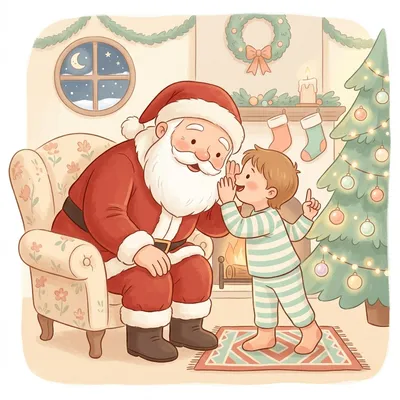
Jolly old Saint Nicholas,Lean your ear this way!Don't you tell a single soulWhat I'm going to say:Christmas Eve is coming soon;Now, you dear old man,Whisper what you'll bring to me;Tell me if you can.
When the clock is striking twelve,When I'm fast asleep,Down the chimney, broad and black,With your pack you'll creep.All the stockings you will findHanging in a row;Mine will be the shortest one,You'll be sure to know.
Johnny wants a pair of skates;Susy wants a dolly;Nellie wants a story book;She thinks dolls are folly.As for me, my little brainIsn't very bright;Choose for me, old Santa Claus,What you think is right.
History and Meaning
Nobody can prove who wrote this song. The words first turn up in December 1865, in a poem titled "Lilly's Secret" printed in The Little Corporal, a children's magazine published in Chicago. Two names have been attached to that poem ever since, and the argument between them has never been closed out. It is one of the best-known Christmas songs in America with one of the emptiest credit lines.
The song itself is quieter than most carols. There is no manger, no sleigh crossing the sky, no crowd of angels. A child has Santa's ear for a moment and is whispering a shopping list into it, sworn to secrecy, and the whole thing is pitched at conversational volume. That intimacy is the reason it works so well with small children, who understand the situation immediately.
Origins
"Lilly's Secret" appeared in the December 1865 issue of The Little Corporal. Emily Huntington Miller (1833 to 1913) was on the staff of that magazine as an editor, and she is the candidate most often named. Miller was a working writer of children's verse and later a figure at Northwestern University, so the poem sits comfortably inside her output.
The rival candidate is Benjamin Hanby (1833 to 1867), the Ohio songwriter who wrote Up on the Housetop around 1864. The Hanby claim rests mostly on resemblance. The two songs share a subject, a bouncy short-line meter, a naming of specific children and specific presents, and the same handful of years. What has not been produced on the Hanby side is a document: no manuscript and no printing from his lifetime carrying his name against these words. Hanby died young, in 1867, which left his catalogue loosely tended for decades afterward.
A third name, John Piersol McCaskey, circulated at one point too, though there is little behind it. McCaskey was a Pennsylvania educator and songbook compiler, and his own Franklin Square Song Collection of 1881 credited the song elsewhere rather than to himself.
The tune arrived later than the words. The melody now sung was published in 1874 in School Chimes, A New School Music Book, and it is commonly attributed to the Cincinnati music editor James R. Murray, who also set Away in a Manger to its American tune. The words and the tune reached most families as school-songbook material, which is exactly the kind of publishing that loses author credits.
Meaning & Interpretation
The three verses move through a small piece of theatre. First the child pulls Santa in close and demands secrecy. Then comes the practical detail of the night itself, midnight, the chimney, the row of stockings on the mantel. The child identifies their own stocking as the shortest one in the row, which is a neat way of saying "I am the smallest here" without saying it.
The last verse is the surprising one. After listing what Johnny, Susy and Nellie want, the child gives up on choosing at all and hands the decision back: "Choose for me, old Santa Claus, what you think is right." Victorian children's verse taught modesty constantly, and that ending is a lesson in it. It also reads, to a modern ear, like a child who simply cannot decide, which may be why it survived when the moralising in similar poems did not.
Who wrote Jolly Old Saint Nicholas?
It is not settled. The words trace to the 1865 poem "Lilly's Secret" in The Little Corporal, and Emily Huntington Miller, an editor at that magazine, is the name most commonly given. Benjamin Hanby is the other proposed author. Neither attribution rests on a signed manuscript, and reference works differ, so the honest answer is that the song is of disputed authorship with Miller as the more frequently cited candidate.
What is "Lilly's Secret"?
It is the title under which these words were first printed, in the December 1865 issue of the Chicago children's magazine The Little Corporal. The secret of the title is the one in the opening lines: the child is telling Santa something no one else is allowed to hear.
Did Benjamin Hanby write Jolly Old Saint Nicholas?
Possibly, but there is no evidence for it beyond similarity. Hanby definitely wrote "Up on the Housetop" around 1864, a song so close in subject and rhythm that his name gets pulled toward this one by association. No document from his lifetime links him to these words, and he died in 1867 without, as far as anyone has shown, claiming them.
Why does the child say their stocking is the shortest one?
It marks them as the youngest or smallest child in the household. Stockings were hung in a row along the mantel, so the shortest one was easy to pick out, and the line works as a set of directions for Santa as well as a quiet piece of self-description.
Related Nursery Rhymes


Lyrics from nurseryrhymes.info