

Away in a Manger


Lyrics
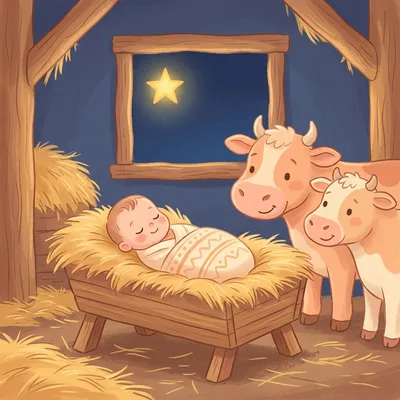
Away in a manger, no crib for a bed,The little Lord Jesus laid down His sweet head.The stars in the bright sky looked down where He lay,The little Lord Jesus, asleep on the hay.
The cattle are lowing, the Baby awakes,But little Lord Jesus, no crying He makes.I love Thee, Lord Jesus! Look down from the sky,And stay by my cradle till morning is nigh.
Be near me, Lord Jesus; I ask Thee to stayClose by me forever, and love me, I pray.Bless all the dear children in Thy tender care,And fit us for heaven, to live with Thee there.
History and Meaning
For over a century, songbooks printed "Away in a Manger" with the credit "composed by Martin Luther for his children". The attribution is false. Luther never wrote it, no early German version exists, and the carol is American, first appearing in church papers in the early 1880s. That mix-up, plus the fact that Britain and America sing it to two completely different tunes, gives this gentle cradle song one of the stranger back-stories in the carol book.
Origins
The first two verses appeared in March 1882 in The Christian Cynosure, a Chicago church newspaper, already labelled as Luther's work. In 1885 they were printed with music in Little Children's Book for Schools and Families, a Philadelphia collection prepared for the Evangelical Lutheran Church. Two years later the Cincinnati music editor James R. Murray set the words to the melody now known as "Mueller" in Dainty Songs for Little Lads and Lasses, adding the confident and wrong note that Luther had composed it for his own children.
The third verse ("Be near me, Lord Jesus") surfaced in 1892 in a collection edited by the gospel songwriter Charles H. Gabriel. A later tradition credits it to the Methodist Sunday-school leader John T. McFarland, but the 1892 printing predates the years in which McFarland was supposed to have written it.
In 1945 Richard S. Hill of the Library of Congress traced the carol through dozens of early songbooks and found no German text and no connection to Luther at all. The likeliest explanation for the false credit is the celebration surrounding the 400th anniversary of Luther's birth in 1883, when publishers wanted Luther material of every kind.
Meaning & Interpretation
The carol works as a bedtime prayer. The first verse paints the stable scene, and the remaining two turn it into a child's own words, asking Jesus to "stay by my cradle" and to "bless all the dear children in Thy tender care". Sung slowly, it doubles as a lullaby, which is why it settled so quickly into both church services and nurseries.
The line "no crying He makes" draws occasional comment from theologians, who point out that a real newborn cries. Most singers take it as lullaby wishfulness rather than doctrine, the same hush a parent hopes for at any cradle.
Did Martin Luther write Away in a Manger?
No. The carol appeared anonymously in American publications in the early 1880s, more than 300 years after Luther's death, and no German original has ever been found. Musicologist Richard S. Hill showed in 1945 that the Luther credit was an American invention, probably inspired by the 1883 celebrations of Luther's 400th birthday.
Why does Away in a Manger have two different tunes?
American congregations mostly sing "Mueller", written by James R. Murray in 1887. British and Commonwealth singers use "Cradle Song", composed by William J. Kirkpatrick in 1895. Each setting spread through its own country's hymnals, so the carol crossed the Atlantic with two musical identities that never merged.
What does "the cattle are lowing" mean?
Lowing is the deep, soft sound cattle make, a gentler word for mooing. In the carol the animals' noise wakes the baby, which sets up the next line about the infant Jesus staying quiet.
Related Nursery Rhymes





Lyrics from nurseryrhymes.info