
Here We Come A-Caroling

Lyrics
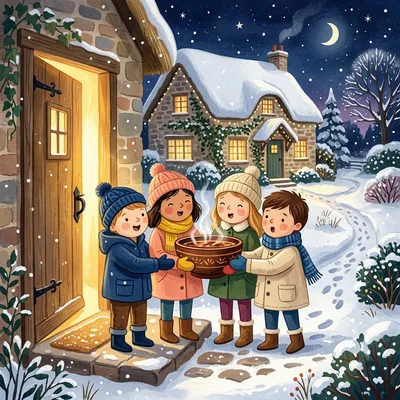
Here we come a-carolingAmong the leaves so green,Here we come a-wanderingSo fair to be seen.
Chorus
Love and joy come to you,And to you your wassail too,And God bless you and send youA Happy New Year,And God send you a Happy New Year.
Our wassail cup is madeOf the rosemary tree,And so is your beerOf the best barley.
We are not daily beggarsThat beg from door to door,But we are neighbours' childrenWhom you have seen before.
History and Meaning
This carol travels under three names. "Here We Come A-Caroling" is the version most children learn today, "Here We Come A-Wassailing" is the older wording, and folk song collections file it as "The Wassail Song". They are the same piece, catalogued as Roud 209. The swap from "wassailing" to "caroling" happened because the original word stopped meaning anything to most singers, and a carol about carol singing is easier to explain to a class of six-year-olds than a carol about a drink nobody has tasted.
The song is not really about singing. It is about knocking on a door in the cold and hoping the people inside hand something out.
Origins
The earliest firm anchor for the words is William Henry Husk's collection Songs of the Nativity, published in London in 1868. Husk printed the carol and noted that it came from a broadside printed at Bradford in Yorkshire "within the last twenty years", which places the printed source somewhere between roughly 1848 and 1868. That is a backward reference rather than a dated sheet, so a flat date of 1850 or 1855 is a guess dressed up as a fact. Mid-nineteenth century is as tight as the evidence honestly allows, and the song itself is very likely older than the broadside that carried it.
Husk also recorded that a Bradford clergyman, the Reverend J. T. Horton, reported the tune was still well known locally and regularly sung by the Christmas waits. Waits were town musicians who went round the streets playing and singing in the weeks before Christmas, and collecting money as they went. The West Riding of Yorkshire is where the paper trail sits, though wassail songs of this general shape turn up across England with different tunes and different verses.
Meaning & Interpretation
Every verse is doing a job. The singers announce themselves, describe their wassail cup, insist on their respectability, and then bless the household. The blessing is the goods being offered: love, joy, and a good new year for the master, the mistress, and the children round the table. Food, drink or a coin is what comes back.
That exchange is the whole point of a luck-visit, the folklore term for a custom where visitors arrive at a door bearing good wishes and leave with something in hand. Wassailing, first-footing on New Year's morning, and souling at Hallowtide all work the same way. The visit is supposed to bring luck to the house, so turning the singers away empty-handed was not just rude, it was unwise.
The reference to a cup "made of the rosemary tree" is usually read as a wooden wassail bowl, sometimes decorated with sprigs of rosemary, which was a common evergreen for garlanding at Christmas.
What does wassail mean?
The word comes from a greeting, not a song. Middle English "wassail" descends from Old Norse "ves heill", matching Old English "wes hal", and it means roughly "be in good health" or "be fortunate". By the twelfth century it had become a drinking salute in England, with the drinker answering "drinkhail". From there the word attached itself to two more things: the spiced drink handed round at Christmas, usually mulled ale or cider with sugar, spices and roasted apples, and the custom of carrying that drink from house to house. So a wassail can be a toast, a bowl, or an evening out.
Is it Here We Come A-Caroling or A-Wassailing?
Both are correct. "A-Wassailing" is the older and more common wording in nineteenth-century printings, and "The Wassail Song" is the standard folk song title. "A-Caroling" spread through twentieth-century school songbooks and American recordings, where it replaced an unfamiliar word with a familiar one. The tune and the rest of the verses are unchanged, and the chorus still says "and to you your wassail too" in nearly every version, caroling included.
What does "we are not daily beggars" mean?
The singers are drawing a hard line between themselves and people who begged for a living. Door-to-door begging was heavily disapproved of and in various periods illegal, so the verse makes the case that these are the neighbours' children, known faces, out on a seasonal custom rather than on the scrounge. The following lines lean on the same idea, describing the singers as children standing in the mud outside while the household sits by the fire.
Is this the same as wassailing apple trees?
No, though the two customs share a name and a bowl. The song belongs to house-visiting wassailing, where singers go door to door. Orchard wassailing is a separate West Country tradition, found mainly in cider counties such as Somerset, Devon, Herefordshire and Gloucestershire, in which people gather in an apple orchard around Twelfth Night, sing to the trees, pour cider on the roots and make noise to encourage a good crop. Different songs, different setting, same underlying idea that a blessing spoken out loud brings luck.
Related Nursery Rhymes


Lyrics from nurseryrhymes.info