

Good King Wenceslas


Lyrics
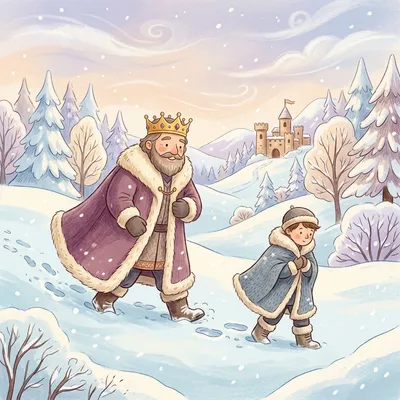
Good King Wenceslas looked out, on the Feast of Stephen,When the snow lay round about, deep and crisp and even;Brightly shone the moon that night, though the frost was cruel,When a poor man came in sight, gath'ring winter fuel.
"Hither, page, and stand by me, if thou know'st it, telling,Yonder peasant, who is he? Where and what his dwelling?""Sire, he lives a good league hence, underneath the mountain,Right against the forest fence, by Saint Agnes' fountain."
"Bring me flesh, and bring me wine, bring me pine logs hither,Thou and I will see him dine, when we bear them thither."Page and monarch, forth they went, forth they went together,Through the rude wind's wild lament and the bitter weather.
History and Meaning
The tune everyone sings at Christmas was written for spring. It comes from Piae Cantiones, a collection of Latin songs printed in 1582, where it carried "Tempus adest floridum", a bright little number about the flowering season arriving and the earth turning green again. In 1853 an English clergyman put a winter charity story on top of it, and the spring song has been buried under snow ever since.
There are five verses in all. The three above set the scene and start the journey. In the fourth the page begins to fail in the cold, and in the fifth he is told to walk in his master's footprints, where the sod is warm, before the carol closes with its instruction to bless the poor.
Origins
John Mason Neale, Warden of Sackville College in East Grinstead, wrote the English words in 1853. They were published that year in Carols for Christmas-tide, issued by Novello, with Thomas Helmore as music editor. Neale and Helmore had recently been handed a rare copy of the 1582 Piae Cantiones by G. J. R. Gordon, the British envoy in Stockholm. The book was more or less unknown in England, and the two men worked through it fitting English texts to melodies they found there.
Neale's words have no connection at all to the Latin original. "Tempus adest floridum" is a song about flowers, bees and the returning warmth. Neale kept the melody and wrote a completely new narrative about a ruler carrying food and firewood through the snow to a peasant's door.
The story behind that narrative is older than either. Wenceslaus I, Duke of Bohemia, was murdered in 935 by followers of his younger brother Boleslav. Medieval accounts of his life describe him going out at night to give alms to the poor, to widows and orphans and prisoners, and it is that reputation, rather than any single documented incident, that Neale turned into a scene.
Meaning & Interpretation
The carol is a lesson in almsgiving dressed as an adventure. The king does not send servants; he asks who the man is, where he lives, and then walks the league to get there himself, in weather described as cruel and bitter. The page's near collapse and the warm footprints make the point that following a generous example is easier than starting out alone.
Not everyone admired it. The editors of the Oxford Book of Carols, Percy Dearmer, Ralph Vaughan Williams and Martin Shaw, called it one of Neale's less happy pieces and openly hoped it would fall out of use, objecting that heavy moralising had been laid over a light dancing spring tune. Their wish did not come true. Later writers have defended it, and the carol remains one of the most sung pieces in the English Christmas repertoire.
Was Good King Wenceslas a real person?
Yes. He was Wenceslaus I, Duke of Bohemia, who died in 935 and was venerated as a saint soon afterwards. He was never a king in his lifetime. The Holy Roman Emperor Otto I is said to have conferred regal dignity and title on him after his death, which is how the duke ended up being called a king in legend and in Neale's carol.
When is the Feast of Stephen?
26 December, the day after Christmas, the feast of Saint Stephen, the first Christian martyr. In Britain it is also Boxing Day. Setting the carol on that date is deliberate: it is traditionally a day associated with charity to the poor, which is exactly what the song is about.
Where does the tune come from?
From Piae Cantiones, a collection of medieval Latin songs published in 1582 and associated with Finland and Sweden. There the melody belonged to "Tempus adest floridum", a spring song about flowers and the end of winter. Neale and Helmore borrowed the tune in 1853 and gave it an entirely new set of words.
What happens in the last two verses?
The page tells his master he cannot go on, the night is dark and the wind is too strong. Wenceslas tells him to follow behind and tread in his own footprints. The page does, finds warmth in the ground where the king has walked, and the carol ends by telling anyone with wealth or rank that blessing the poor brings blessing in return.
Related Nursery Rhymes



Lyrics from nurseryrhymes.info