

Christmas Comes But Once a Year


Lyrics
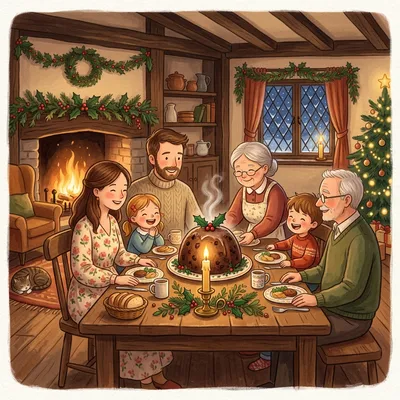
At Christmas play and make good cheer,For Christmas comes but once a year.
Christmas comes but once a year,And when it comes it brings good cheer.
History and Meaning
This one started life as farming advice. The couplet comes from Thomas Tusser, a Tudor writer who put an entire manual of agricultural and household instruction into rhyming verse so that farm workers could carry it in their heads. Nobody wrote it for children. It survived because it rhymed, and because the excuse it offers has never gone out of fashion.
Two short versions circulate. The first is Tusser's own line. The second, "Christmas comes but once a year, and when it comes it brings good cheer", is the later proverbial form that turns up in carol books and school collections. Children usually learn the second one.
Origins
The line appears in Tusser's Five Hundred Pointes of Good Husbandrie, published in 1573, in a chapter titled "The Farmer's Daily Diet". Under the heading for Christmas he writes: "At Christmas play and make good cheere, for Christmas comes but once a yeere." The spelling is Elizabethan; the sentiment is exactly what people mean by it today.
Tusser was born around 1524 at Rivenhall in Essex and died on 3 May 1580. His route to farming was unusual. He sang as a boy chorister at Wallingford Castle, moved on to St Paul's Cathedral, then went to Eton, King's College Cambridge and Trinity Hall. He spent about ten years as a court musician in the service of William Paget, 1st Baron Paget, before marrying and settling as a farmer at Cattawade in Suffolk. After that he moved repeatedly, farming and singing in Ipswich, West Dereham, Norwich Cathedral, Fairstead and Chesterton.
The book came out first in 1557 as A Hundreth Good Pointes of Husbandrie, printed by Richard Tottel. Tusser kept expanding it, and the 1573 enlargement to five hundred points was among the best-selling poetry books of the Elizabethan age. Several English sayings have their earliest known form in it. "A foole and his monie be soone at debate" is the ancestor of "a fool and his money are soon parted". "It is an ill wind turns none to good" became "it's an ill wind that blows nobody any good". Tusser did not necessarily invent these; his book is simply where they first got written down and printed widely enough to stick.
Meaning & Interpretation
Read it inside the farming year and the meaning sharpens. Tusser's book is organised month by month, telling a farmer what to sow, mend, salt, store and pay for at each point in the calendar. December and January are the low-labour months. The livestock that could not be fed through winter had been slaughtered, the grain was in, and there was a legitimate pause. Tusser's Christmas chapter is a permission slip written into the schedule: eat well now, keep an open house, because the work resumes and this only happens once.
That is why the couplet reads as a defence rather than a description. It answers an unspoken objection about the expense and the idleness. Later generations kept using it the same way, as the standard reply to anyone counting the cost of a second helping.
Is this the same as Christmas Is Coming?
No. They are two different rhymes that people mix up constantly. Christmas Is Coming is the Victorian round about the goose getting fat and the penny in the old man's hat, first printed around 1885. "Christmas Comes But Once a Year" is a Tudor couplet from 1573 with no goose, no penny and no round. Both are English, both are about Christmas generosity, and neither is a version of the other.
Who was Thomas Tusser?
Thomas Tusser (c. 1524 to 1580) was an English poet and farmer from Essex. He trained as a chorister and musician, worked at court for Lord Paget, then farmed in Suffolk and elsewhere. His verse manual on husbandry and housewifery, expanded to five hundred points in 1573, was one of the most reprinted books of its century, and he is buried in the lost church of St Mildred in the Poultry, London.
Why did Tusser write farming advice in rhyme?
Rhyme and metre made the instructions memorable for people who could not easily consult a book in a field. The whole work is built as verse for that reason, arranged month by month so a farmer or housewife could recall the right task at the right time. It also explains why so many of his lines survived as proverbs while the farming advice around them was forgotten.
Related Nursery Rhymes





Lyrics from nurseryrhymes.info