

Up on the Housetop


Lyrics
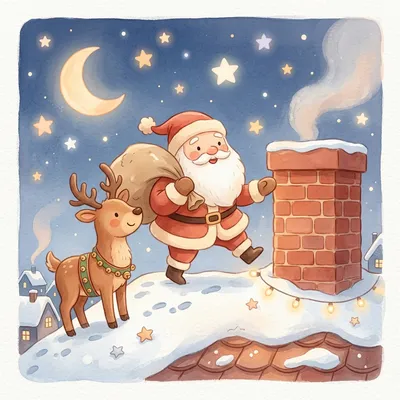
Up on the housetop reindeer pause,Out jumps good old Santa Claus;Down through the chimney with lots of toys,All for the little ones, Christmas joys.
Chorus
Ho, ho, ho! Who wouldn't go?Ho, ho, ho! Who wouldn't go?Up on the housetop, click, click, click,Down through the chimney with good Saint Nick.
First comes the stocking of little Nell;Oh, dear Santa, fill it well.Give her a dolly that laughs and cries,One that will open and shut her eyes.
Chorus
Ho, ho, ho! Who wouldn't go?Ho, ho, ho! Who wouldn't go?Up on the housetop, click, click, click,Down through the chimney with good Saint Nick.
Next comes the stocking of little Will;Oh, just see what a glorious fill!Here is a hammer and lots of tacks,Also a ball and a whip that cracks.
Chorus
Ho, ho, ho! Who wouldn't go?Ho, ho, ho! Who wouldn't go?Up on the housetop, click, click, click,Down through the chimney with good Saint Nick.
History and Meaning
A country preacher in New Paris, Ohio wrote this song for his singing pupils in 1864, and he called it "Santa Claus". There is no manger in it, no shepherds, no star. It is four minutes of reindeer hooves on shingles and toys coming out of a sack, which made it one of the earliest American Christmas songs to leave the nativity out entirely and hand the holiday over to Santa.
The writer was Benjamin Russell Hanby, and he was thirty-one years old at the time. He died three years later of tuberculosis, at thirty-three, without ever knowing that the little sing-along would outlast almost everything else he wrote.
Origins
Hanby (1833 to 1867) was the son of a United Brethren bishop whose house in Westerville, Ohio was a stop on the Underground Railroad. He studied at Otterbein University, taught school, preached, and wrote roughly eighty songs in a working life of about a decade. His first hit was "Darling Nelly Gray" in 1856, an antislavery ballad about a woman sold away from the man who loved her, which became one of the most widely sung abolitionist songs in the country. He also wrote the Christmas hymn "Who Is He in Yonder Stall?".
By Christmas 1864 he had left the pulpit at New Paris and was running a singing school there. "Santa Claus" was written for his students to perform. It reached print in October 1866, when the Chicago publisher Root and Cady included it in volume four of their quarterly children's collection Our Song Birds, and it appeared again the same year in Chapel Gems for Sunday Schools. The John Church company in Cincinnati republished it afterwards, and somewhere along the way the title drifted to the words people actually remembered, "Up on the Housetop".
The music historian William Studwell rated it the second-oldest secular Christmas song in wide use, behind only "Jingle Bells" from 1857, and the first to make Santa Claus its main subject. The rooftop and the chimney were not Hanby's invention. Clement Clarke Moore had already sent the sleigh onto the roof and Saint Nicholas down the flue in Twas the Night Before Christmas, published in 1823. What Hanby did was take that image, strip out Moore's long storytelling lines, and set it to a tune a room full of children could shout.
Meaning & Interpretation
The song is built as a delivery report. Verse one is the arrival, and the two verses after it open the stockings one child at a time. Nell gets "a dolly that laughs and cries, one that will open and shut her eyes", which describes a real and expensive toy of the 1860s: a doll with weighted glass eyes that closed when she was laid down, and sometimes a bellows in the body that produced a cry. Will gets a hammer and tacks, a ball, and a whip that cracks. Toy whips were sold for children playing at driving a horse team or for keeping a spinning top going. The gifts are split along the boy and girl lines of the period, and they are modest, practical objects rather than anything grand.
"Click, click, click" is the sound of hooves on a roof, and it is the part small children learn first. The chorus asks "who wouldn't go?", which is Santa's own line: given the chance to fly around delivering toys, who would turn it down.
Who wrote Up on the Housetop?
Benjamin Russell Hanby, an Ohio songwriter, teacher and United Brethren preacher, wrote both words and music in 1864 while running a singing school in New Paris, Ohio. He titled it "Santa Claus". Hanby also wrote the antislavery ballad "Darling Nelly Gray" and the hymn "Who Is He in Yonder Stall?" before dying of tuberculosis in 1867 at the age of thirty-three.
Is Up on the Housetop the oldest Christmas song about Santa Claus?
It is among the oldest. Music historian William Studwell called it the second-oldest widely sung secular Christmas song after "Jingle Bells" of 1857, and the first one to put Santa Claus at the centre rather than treating him as a passing reference. The imagery of reindeer on the roof and a descent down the chimney came earlier, from Clement Clarke Moore's 1823 poem, but Moore's piece was a poem before it was a song.
Who are Nell and Will in the song?
They are the two children whose stockings Santa fills, invented by Hanby as stand-ins for any brother and sister listening. Nell receives a doll that cries and closes its eyes, Will receives a hammer, tacks, a ball and a toy whip. Naming them lets the song move from a general scene of Santa arriving to the specific moment children care about, which is what is inside their own stocking.
Related Nursery Rhymes


Lyrics from nurseryrhymes.info