

Under the Spreading Chestnut Tree

Lyrics
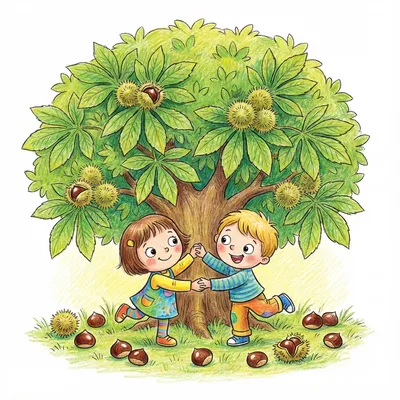
Under the spreading chestnut tree,There we sit both you and me.Oh, how happy we will beUnder the spreading chestnut tree.
I love you and you love me,Under the spreading chestnut tree.
History and Meaning
"Under the Spreading Chestnut Tree" works by erasing itself: with each repeat, another word is swapped for a gesture, arms wide for "spreading," hands on chest for "chest," until almost the whole verse is mimed in silence. It caught on in 1930s British scouting, and George Orwell even slipped it into Nineteen Eighty-Four.
What is the origin of Under the Spreading Chestnut Tree?
The song's origins are somewhat obscure. The title and opening line echo Henry Wadsworth Longfellow's famous 1840 poem "The Village Blacksmith," which begins "Under a spreading chestnut-tree / The village smithy stands." However, the action song bears no other connection to Longfellow's poem beyond the shared image.
The song appears to have emerged in the 1930s within the British scouting and guiding movement, where action songs were a popular campfire activity. It quickly spread to schools, holiday camps, and community gatherings. Dance bands picked it up soon after, turning the simple chant into a foxtrot-style novelty tune that enjoyed brief popularity on the radio.
How do you perform the actions for the song?
The song uses a system of gestures that replace key words as the verses progress:
- "Spreading": arms stretched wide to mimic tree branches.
- "Chestnut": hands on chest.
- "Tree": arms raised overhead like branches.
- "There I used to sit": mime sitting down or pat knees.
- "On her knee" or "with me": point to someone or mime a hug.
As the song repeats, more words are replaced by actions until almost the entire verse is performed in mime with only a few words sung aloud. This progressive substitution is what makes the song so entertaining, as it becomes a memory game as well as a song.
Why is the song beneficial for young children?
The song combines several learning elements in a single activity:
- Memory and sequencing: Children must remember which words have been replaced by actions.
- Coordination: Performing the right gesture at the right moment requires listening skills and motor control.
- Group participation: The song works best with a crowd, building a sense of community and shared fun.
- Confidence: Even shy children can participate through actions without having to sing loudly.
How is the song referenced in George Orwell's Nineteen Eighty-Four?
The song gained unexpected literary fame when George Orwell referenced it in his 1949 novel "Nineteen Eighty-Four." In the novel, the song appears as a fragment of pre-revolutionary culture, and its innocent simplicity stands in stark contrast to the oppressive world of Big Brother, a poignant reminder of a gentler time.
Related Nursery Rhymes


Lyrics from nurseryrhymes.info