
A Farmer Went Trotting


Lyrics
Sit the child on your knees, facing you, and hold their hands.Bounce steadily on the long lines, with a bigger bump on each "bumpety".
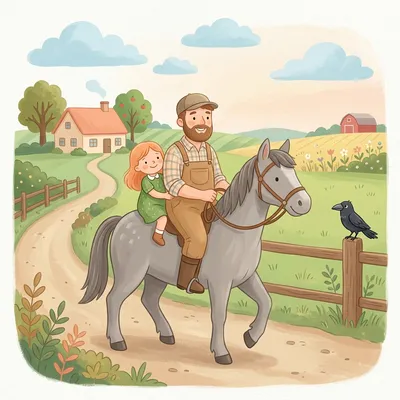
A farmer went trotting upon his grey mare,Bumpety, bumpety, bump!With his daughter behind him so rosy and fair,Lumpety, lumpety, lump!
Croak like a raven, then open your knees so the child dips down.
A raven cried "Croak!" and they all tumbled down,Bumpety, bumpety, bump!The mare broke her knees and the farmer his crown,Lumpety, lumpety, lump!
Flap your hands away like wings, then start the trotting again.
The mischievous raven flew laughing away,Bumpety, bumpety, bump!And vowed he would serve them the same the next day,Lumpety, lumpety, lump!
History and Meaning
This is a knee-bounce rhyme first and a story second. An adult sits the child on their knees and trots in time with the words, and on the third verse the knees part just enough for the child to drop a few inches while everyone in the rhyme falls off the horse. Most people who look the words up are looking for the bounce, not the poem.
The nonsense refrains do the work. "Bumpety, bumpety, bump" and "lumpety, lumpety, lump" have no meaning at all, but they set the rhythm of a horse at a trot and they tell you exactly where the beat lands. Children learn to anticipate the drop within two or three goes, which is the whole point of the game.
Origins
The rhyme is English and its best documented appearance is Randolph Caldecott's picture book of 1884, published in London by George Routledge and Sons. Caldecott paired it in one volume with "Ride a Cock-Horse to Banbury Cross", and the drawings he made for it carried the verse to a very wide readership on both sides of the Atlantic. His illustration of the farmer and the grey mare is held today in museum print collections.
Older origins are often claimed for it. One frequently repeated line has the verse printed in a nursery collection in 1805, but that early appearance has not been independently confirmed, so it is worth treating as unverified rather than fact. What can be said safely is that Caldecott was drawing on a rhyme that already circulated by word of mouth, since his books took existing nursery verses rather than invented ones.
Caldecott himself deserves the credit for how well the rhyme survived. He was one of the most influential illustrators of Victorian children's books, working with the colour printer Edmund Evans, and he is frequently described as the father of the modern picture book for the way he let pictures carry action the words leave out. He died in 1886, aged thirty-nine. In 1938 the American Library Association established the Caldecott Medal in his name, awarded every year to the illustrator of the most distinguished American picture book for children, and the bronze medal carries images taken from his own drawings.
Meaning & Interpretation
The story is small and complete. A farmer rides to market on a grey mare with his daughter sitting behind him, a raven croaks, the startled horse throws them, and the bird flies off promising to do it again tomorrow. The farmer breaks his "crown", which is an old word for the top of the head, and the mare breaks her knees, an expression that meant a horse had gone down on its forelegs.
The tumble is played for comedy, not alarm. Nobody is described as hurt beyond the fall itself, the raven laughs, and the verse ends with a threat that is really a joke about doing the whole game again. Ravens turn up in a lot of older English verse as noisy troublemakers with a whiff of bad luck about them, and this one is a mischief-maker rather than an omen.
The daughter "so rosy and fair" is the only description anyone gets. It fixes the scene as an ordinary market-day errand, which makes the sudden fall funnier than it would be if the rhyme had set up anything grand.
How do you do the knee-bounce?
Sit down, put the child on your knees facing you, and hold their hands or steady them at the waist. Bounce your heels in a steady trot through each long line, then give a bigger bump on each "bumpety" and "lumpety". At "they all tumbled down", open your knees a little and let the child dip safely between them before pulling them back up. Then start trotting again for the last verse. Keep the drop small for babies and make it bigger as the child gets used to it.
What does "the farmer his crown" mean?
Crown here means the top of the head, the same sense used in "Jack fell down and broke his crown" in "Jack and Jill". The farmer landed on his head. The matching phrase about the mare breaking her knees describes a horse falling onto its front legs, which was a common enough accident that it had its own set expression.
Why does the raven make the horse fall?
A sudden loud croak close by is exactly the sort of noise that spooks a horse, and the rhyme uses that as its punchline. The bird is written as deliberately mischievous rather than accidental, since it flies off laughing and promises to repeat the trick the following day, which sets up the rhyme to be played again straight away.
What age is this rhyme for?
It suits babies who can sit up with support, usually from around six months, through to toddlers of two or three who can say the "bumpety bump" parts themselves. Younger babies get the rhythm and the gentle motion. Older children get the joke and start asking for the drop.
Related Nursery Rhymes
Lyrics from nurseryrhymes.info