
Bluebird, Bluebird

Lyrics
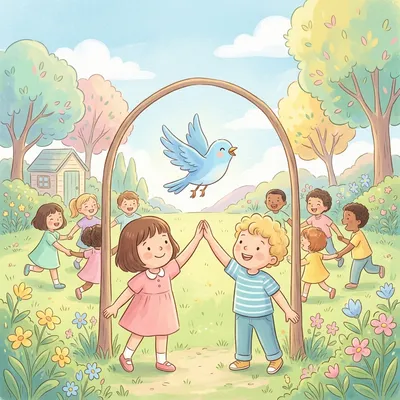
The children join hands in a ring and raise their arms high to make the windows.
Bluebird, bluebird, through my window,Bluebird, bluebird, through my window,Bluebird, bluebird, through my window,Oh, Johnny, I am tired.
One child, the bluebird, weaves in through one window and out through the next, all the way round the ring.
Take a little partner, tap her on the shoulder,Take a little partner, tap her on the shoulder,Take a little partner, tap her on the shoulder,Oh, Johnny, I am tired.
The bluebird stops behind a child in the ring and taps that child's shoulders in time with the beat.
The tapped child becomes the next bluebird, and the game begins again.
History and Meaning
The game needs no equipment and no more space than a classroom rug. Children hold hands in a circle and lift their joined arms to make an arch between each pair of neighbours. Those arches are the windows. One child, the bluebird, threads in through one window and out through the next while everybody else sings, and by the last line a new bluebird has been picked. A four-year-old can learn the whole thing in a single round, which is most of the reason it has stayed on playgrounds for well over a century.
It belongs to a large family of window-weaving singing games that folklorists were collecting in America and Britain by the 1880s. Its nearest relative is Go In and Out the Window, which uses the same ring, the same raised arches and the same weaving path, set to different words.
Origins
William Wells Newell's Games and Songs of American Children, first published in 1883, is the founding collection for this group of American ring games. Newell wrote down tunes, words and rules together, gathering them from children at play and from adults recalling their own childhoods. His book includes an entry at No. 51 titled "Blue-birds and Yellow-birds," placed in the section he set aside for bird and beast games, and song indexes point back to that entry as the earliest print record of the bluebird singing game. The exact wording most people sing today, "Bluebird, bluebird, through my window," spread later and has no single known author.
Related versions surfaced elsewhere in the same period. Robert Ford printed a Scottish text called "The Blue Bird" in Children's Rhymes, Children's Games, Children's Songs (1904). In 1935 Alan Lomax, Zora Neale Hurston and Mary Elizabeth Barnicle recorded African American children in Georgia singing a version of it, one of the earliest sound recordings of the game rather than a printed text of it. Iona and Peter Opie later catalogued it under the plain heading "Bluebird" in their survey of singing games.
No single year can be attached to it. The song moved by ear from child to child for decades before anyone wrote it down, and the collectors who finally did were recording something already old and already varied.
Meaning & Interpretation
There is nothing hidden to work out here. The words are stage directions set to a tune, and the bird is a device that turns a weaving path into flight. Windows made of arms, a bird passing through them, a tap on the shoulder: the song describes exactly what the players' bodies are doing while they sing it.
The last line, "Oh, Johnny, I am tired," works as a signal rather than a sentiment. It tells the ring that the verse has ended and the bluebird must stop and choose. Regional versions differ on it freely. Some sing "Oh, Johnny, aren't you tired," some "Oh, Johnny, I'm so tired," and the name in the line changes to whatever a group happens to use.
What teachers get out of it is movement rather than meaning: steady beat, in-and-out sequencing, body awareness in a crowded circle, and a turn-taking system where a child rather than an adult decides who goes next.
How do you play Bluebird, Bluebird?
Stand the children in a circle facing inward, holding hands, then have them raise their joined hands to shoulder height or higher so that each pair of neighbours forms an arch. Choose one child to be the bluebird and place them outside the ring. As the group sings the first verse, the bluebird weaves in through one arch and out through the next, continuing around the circle so long as the singing lasts. The ring keeps the arches up and keeps singing. On the second verse, the bluebird stops behind whichever child they have reached, puts their hands on that child's shoulders, and taps gently in time with the beat until the verse finishes. The tapped child then becomes the new bluebird, and everybody sings the song again from the start. Nobody leaves the circle and nobody is eliminated, so the game can run as long as attention holds.
Why do the endings differ from one version to another?
Because the game was passed on by children rather than by a printed rule book, the closing move never settled into one form. The most common ending has the bluebird tap a chosen child, who takes over as the next bird while the old bird joins the ring. In other versions the two swap places outright. In others again the tapped child holds onto the bluebird's waist and follows along, so the bird grows into a chain that weaves through the shrinking circle until only a couple of arches are left. The "take a little partner" line is itself optional and is missing from plenty of versions, which simply repeat the bluebird verse and end with a tap. Pick one ending, teach it clearly, and expect children who learned it elsewhere to insist on a different one.
What age is Bluebird, Bluebird suitable for?
It works best from about three to seven. Younger players manage the weaving with an adult walking the path once first, and the tapping gives them a clear, physical way to hand the turn on without needing to be chosen by a grown-up. Older children usually want the chain version, which adds the challenge of steering a line of followers through a narrowing set of arches.
Related Nursery Rhymes
Lyrics from nurseryrhymes.info