
Bingo


Lyrics
There was a farmer had a dog,and Bingo was his name-o.B-I-N-G-OB-I-N-G-OB-I-N-G-OAnd Bingo was his name-o.
There was a farmer had a dog,and Bingo was his name-o.(clap)-I-N-G-O(clap)-I-N-G-O(clap)-I-N-G-OAnd Bingo was his name-o.
There was a farmer had a dog,and Bingo was his name-o.(clap)-(clap)-N-G-O(clap)-(clap)-N-G-O(clap)-(clap)-N-G-OAnd Bingo was his name-o.
There was a farmer had a dog,and Bingo was his name-o.(clap)-(clap)-(clap)-G-O(clap)-(clap)-(clap)-G-O(clap)-(clap)-(clap)-G-OAnd Bingo was his name-o.
There was a farmer had a dog,and Bingo was his name-o.(clap)-(clap)-(clap)-(clap)-O(clap)-(clap)-(clap)-(clap)-O(clap)-(clap)-(clap)-(clap)-OAnd Bingo was his name-o.
There was a farmer had a dog,and Bingo was his name-o.(clap)-(clap)-(clap)-(clap)-(clap)(clap)-(clap)-(clap)-(clap)-(clap)(clap)-(clap)-(clap)-(clap)-(clap)And Bingo was his name-o.
History and Meaning
"Bingo" (commonly spelled "B-I-N-G-O" or titled "Bingo Was His Name-O") is a traditional English-language children's song and spelling game. Celebrated for its cumulative structure and clap-along format, the song is a staple of early childhood classrooms, campfires, and daycare centers worldwide.
The song serves as an educational tool, helping children build rhythmic coordination, letter recognition, and motor control.
Origins
The song has a documented history that dates back to the late eighteenth century. The earliest known printed version of the lyrics and sheet music appeared in London in 1780. In this publication, the song was attributed to William Swords, an actor at the Haymarket Theatre in London. An early version was also collected in 1785 by the classical music antiquarian, John Stafford Smith. The song traveled to North America and was adapted into various folk and playground traditions during the nineteenth century.
Meaning & Interpretation
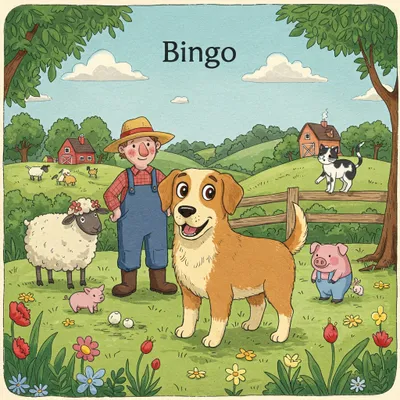
The lyrics tell a simple story of a farmer who has a dog named Bingo. The spelling portion of the song is designed as a memory and coordination game. In the first verse, children spell out B-I-N-G-O. In each subsequent verse, a letter is dropped, starting with the B, and replaced by a handclap (or other gestures like a bark or a stamp of the foot). By the final verse, all five letters are replaced by claps. This structure teaches children how to keep time, hold their impulses, and follow structured rules while spelling.
Who wrote the song B-I-N-G-O?
The earliest recorded version of the song from 1780 attributes the piece to William Swords, a London actor. However, like most traditional folk songs, it likely evolved from older oral counting and spelling games before being transcribed.
How does the clapping game in Bingo work?
The game works by repeating the main verse while gradually replacing letters of the dog's name with claps. Each turn, children drop one more letter from the beginning (first "B," then "I," and so on) and clap in its place until the entire name is spelled with five claps.
Music Video
If the player is unavailable, watch this video on YouTube.
Related Nursery Rhymes
Lyrics from nurseryrhymes.info