

Old MacDonald Had a Farm


Lyrics
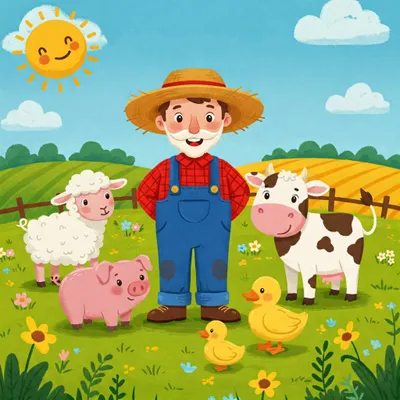
Old MacDonald had a farmEe-i ee-i ohAnd on his farm he had some cowsEe-i ee-i oh
With a moo-moo hereAnd a moo-moo thereHere a moo, there a mooEverywhere a moo-moo
And on his farm he had some pigsEe-i ee-i ohWith an oink-oink hereAnd an oink-oink there
Here an oink, there an oinkEverywhere an oink-oinkOld MacDonald had a farmEe-i ee-i oh
And on his farm he had some [insert animal]Ee-i ee-i ohWith an [animal sound x2] hereAnd an oink-oink there
Here an [animal sound], there an [animal sound]Everywhere an [animal sound x2]Old MacDonald had a farmEe-i ee-i oh
Repeat for as many animals on the farm as you'd like.
History and Meaning
"Old MacDonald Had a Farm" works by piling up animals. Each verse adds a new beast and the noise it makes, and the singers rattle back through the whole farmyard. The E-I-E-I-O refrain means nothing at all; it is rhythmic filler that holds the verses together, which is part of why children take to it so easily.
Origins
The song has a long history that predates the modern version. A cumulative folk song called "The Farmyard" was collected in England during the late nineteenth century. However, the earliest printed version containing the modern structure was "Old MacDougal Had a Farm," published in the 1917 British compilation of soldier songs, Tommy's Tunes. The song migrated to the United States, where the name was changed to MacDonald. Early commercial recordings, such as the 1925 version by the Sam Patterson Trio, popularized the now-familiar melody and the "E-I-E-I-O" refrain.
Meaning & Interpretation
The song is a cumulative list of farm animals, with each verse adding a new animal and its associated sound. Singing the song requires memory and sequencing as children repeat the sounds in reverse order or list them together. The phrase "E-I-E-I-O" is a nonsense refrain typical of traditional English-language folk ballads, used to bridge verses and maintain the rhythm.
The song is highly educational. It serves as a tool for speech development by encouraging children to practice vocalizing onomatopoeic animal sounds like "moo," "oink," and "cluck." The repetitive format reinforces memory, vocabulary, and active participation.
Who wrote Old MacDonald Had a Farm?
The song is a traditional folk song with anonymous origins. An early documented version with the modern structure was compiled by F. T. Nettleingham and published in 1917 under the title "Old MacDougal Had a Farm."
When was Old MacDonald Had a Farm first printed?
The modern version of the song was first printed in 1917 in London. It became widely popular in North America through commercial recordings during the 1920s.
Music Video
If the player is unavailable, watch this video on YouTube.
Free Printable Coloring Page
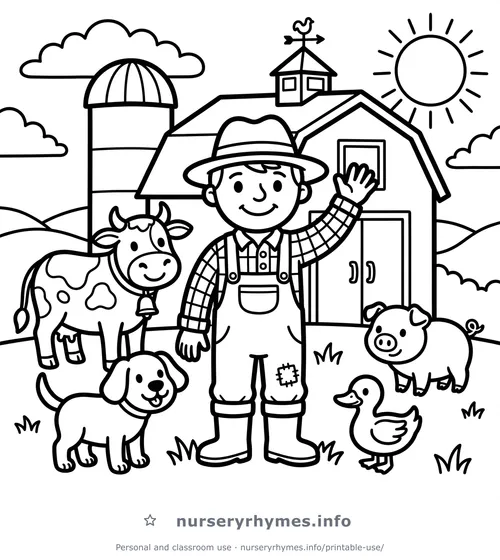
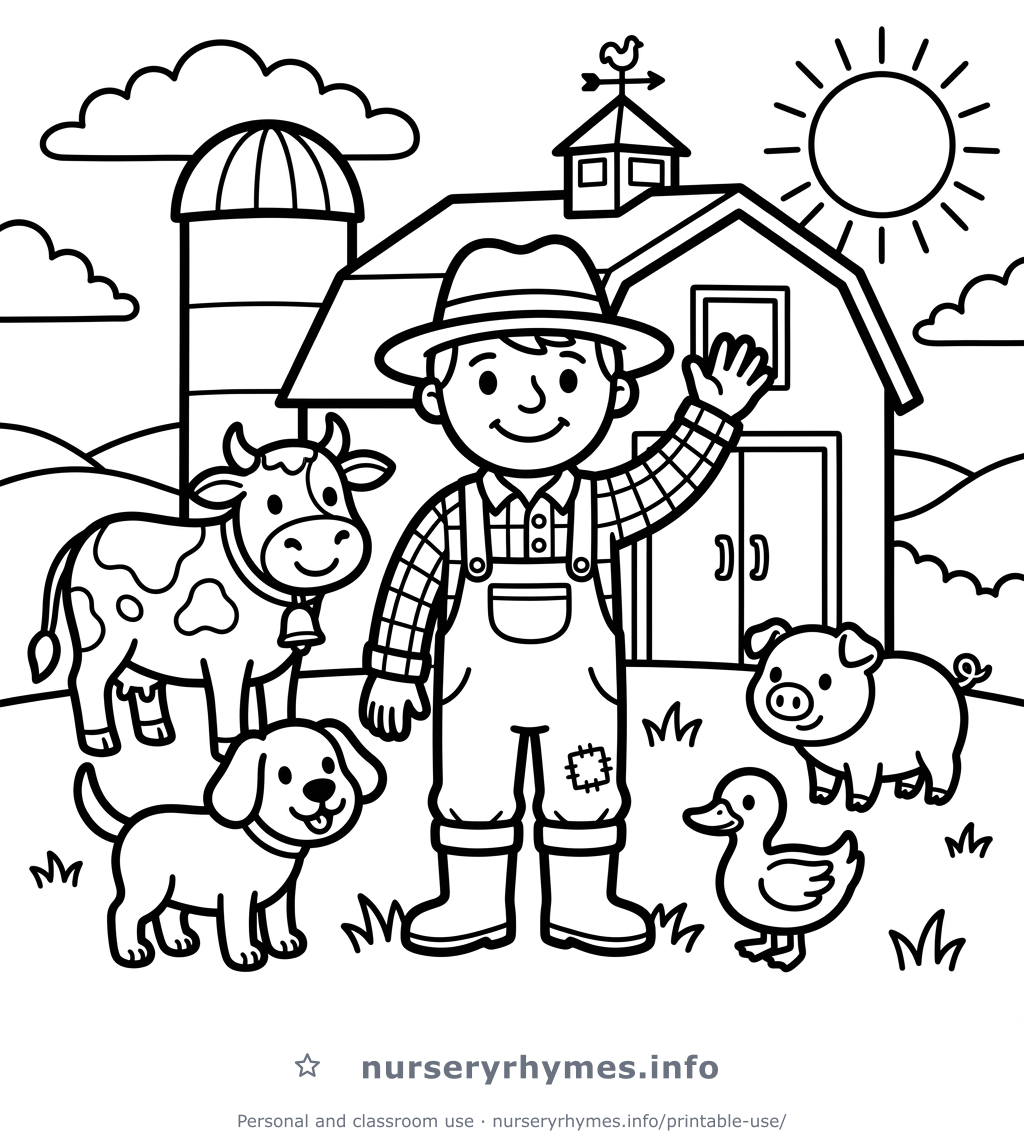
Print this Old MacDonald Had a Farm coloring sheet for free and let little ones bring it to life with crayons or pencils.
Full-resolution PNG · Fits the paper size selected in your print dialog · Personal and classroom use
Related Nursery Rhymes



Lyrics from nurseryrhymes.info