
Old Mother Goose


Lyrics
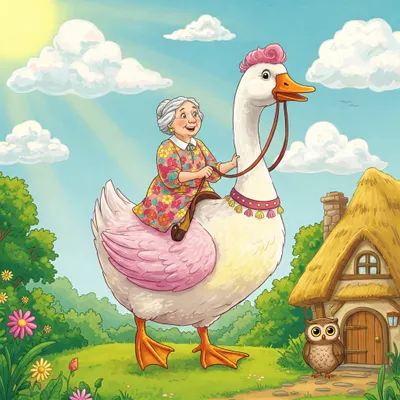
Old Mother Goose, whenshe wanted to wander,Would ride through the airOn a very fine gander.
Mother Goose had a house,‘Twas built in a wood.An owl at the doorFor a porter stood.
She had a son Jack,A plain-looking lad.He was not very good,Nor yet very bad.
She sent him to market,A live goose he bought.“Here! Mother,” says he,“It will not go for naught.”
Jack’s goose and her ganderGrew very fond;They’d both eat together,Or swim in the pond.
Jack found one morning,As I have been told,His goose had laid himAn egg of pure gold.
Jack rode to his mother,The news for to tell.She called him a good boyAnd said it was well.
And Old Mother GooseThe goose saddled soon,And mounting its back,Flew up to the moon.
History and Meaning
Mother Goose is the name on a thousand nursery rhyme books, but here she gets a story of her own: she rides through the air on a gander, her son Jack buys a goose that lays a golden egg, and she ends up flying to the moon. The verse came from an 1806 London pantomime, not the folk tradition.
Origins
The character of Mother Goose has roots in seventeenth-century French folklore, where the term "Ma Mère l'Oye" was used to describe older women telling stories to children. In 1697, Charles Perrault published his famous fairy tale collection under that name. The specific nursery rhyme about Mother Goose flying on a gander, cataloged as Roud Folk Song Index number 20252, became famous in London in 1806. It was written to accompany the highly successful pantomime Harlequin and Mother Goose; or, The Golden Egg, which starred the celebrated comic actor Joseph Grimaldi.
Meaning & Interpretation
The narrative describes Mother Goose riding through the air on a gander. Her son Jack buys a live goose that surprises them by laying an egg of pure gold. Jack tells his mother, who then saddles the goose and flies up to the moon.
The story combines traditional European folk motifs of golden eggs with theatrical comedy. It was designed to capture the wonder of young audiences during pantomime performances. Over time, the character became so closely associated with children's songs that publishers began grouping all traditional nursery rhymes under the title of Mother Goose.
Who was the real Mother Goose?
There is no single historical figure named Mother Goose. The name represents a legendary storyteller, originating from French folk tales and popularized in English publishing by John Newbery and early pantomimes.
What is the history of the Old Mother Goose nursery rhyme?
The rhyme was written in London around 1806 for a theatrical pantomime titled Harlequin and Mother Goose; or, The Golden Egg. The performance popularized the story of the golden egg and established the image of Mother Goose riding a flying gander.
Music Video
If the player is unavailable, watch this video on YouTube.
Lyrics from nurseryrhymes.info