

The Animals Went In Two by Two
Lyrics
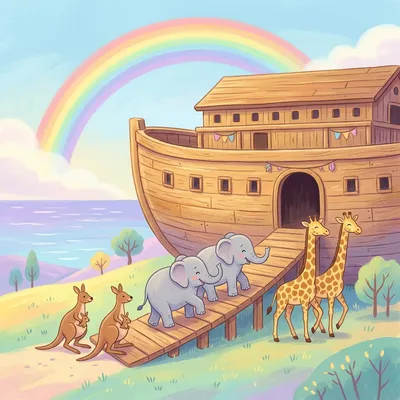
The animals went in two by two, hurrah! hurrah!The animals went in two by two, hurrah! hurrah!The animals went in two by two,The elephant and the kangaroo,And they all went into the ark,For to get out of the rain.
The animals went in three by three, hurrah! hurrah!The animals went in three by three, hurrah! hurrah!The animals went in three by three,The wasp, the ant and the bumblebee,And they all went into the ark,For to get out of the rain.
The animals went in four by four, hurrah! hurrah!The animals went in four by four, hurrah! hurrah!The animals went in four by four,The great hippopotamus stuck in the door,And they all went into the ark,For to get out of the rain.
The animals went in five by five, hurrah! hurrah!The animals went in five by five, hurrah! hurrah!The animals went in five by five,The bees came swarming from the hive,And they all went into the ark,For to get out of the rain.
History and Meaning
The tune is not a children's tune at all. It is "When Johnny Comes Marching Home", the marching song deposited at the Library of Congress on 26 September 1863 and sung across the American Civil War by people waiting for soldiers to come back. Somewhere in the second half of the nineteenth century, British children fitted a Noah's Ark counting rhyme to it, kept the "hurrah! hurrah!" exactly where the soldiers had it, and turned a war song into a nursery song about a hippopotamus getting stuck in a door.
Most families sing this one, The Ants Go Marching and When Johnny Comes Marching Home without ever noticing the three are the same melody.
Origins
"When Johnny Comes Marching Home" was published in Boston in 1863 by Henry Tolman and Co., credited to "Louis Lambert". That was a pen name for Patrick Gilmore, an Irish-born bandmaster then leading Union army bands. Gilmore was honest about the melody twenty years later. Writing in the Musical Herald in 1883, he called it "a musical waif which I happened to hear somebody humming in the early days of the rebellion", which he had written down, dressed up and given a name. The same melody had already appeared a few months earlier in 1863 attached to a soldiers' drinking song, "Johnny Fill Up the Bowl".
The ark words came later and no author is known for them. They circulated as a traditional children's and camp song rather than a published composition, which is why you will find the verses in slightly different orders, with different animals, depending on which songbook or school you learned them in. This is the reason no single date belongs on the lyrics: 1863 is the tune's date, not the rhyme's, and the two get run together constantly. The words are simply nineteenth century, with no firm year attached.
Meaning & Interpretation
The frame is the flood story from Genesis, in which Noah loads pairs of every animal onto a boat before the rain arrives. The song keeps only the parts a small child can picture: rain, a door, a queue of animals, and a very large boat. There is no moral at the end and no theology in the verses. The ark is a container for a joke about how many creatures you can fit through a doorway.
What actually drives the song is the counting. Each verse names a number, then finds an image that rhymes with it. Three brings the bumblebee, four brings the door, five brings the hive. A child learning the sequence gets two supports at once: the number itself, sung three times before the rhyme lands, and a picture attached to it. Because the numbers run in order and the melody never changes, children can predict what comes next and join in on the "hurrah" long before they can hold the whole verse.
Singers rarely stop at five. The verses usually run up to ten and sometimes further, with lines such as the pig at seven who thought he was going to heaven, the latecomers rushing in at eight, and the ark blowing its whistle at ten. Groups often invent their own once the pattern is obvious, which is exactly how a song like this stays alive.
Why does it sound like The Ants Go Marching?
Because it is the same tune. Both songs borrow the melody of "When Johnny Comes Marching Home", and both use its structure: a line sung twice with "hurrah! hurrah!", a third statement, a rhyming line, then a closing refrain. "The Ants Go Marching" is the American branch of the family, in which the little one stops to suck his thumb, tie his shoe, shut the door, and so on. "The Animals Went In Two by Two" is the British branch, with Noah's ark instead of an ant column. Neither borrowed from the other; they each borrowed from Gilmore.
How many verses does the song have?
There is no fixed number. Printed versions commonly run from two up to ten, and some go higher or stop early depending on the age of the singers. Since the song was passed around by ear rather than fixed in a single publication, the animals and actions vary between versions too.
Is it a Bible song?
It uses the Noah's Ark story as a setting, but it is not a hymn and was not written for worship. The verses stay with the animals and the rain, and the song turns up in nurseries, playgroups and school assemblies simply as a counting song with a familiar picture behind it.
Related Nursery Rhymes
Lyrics from nurseryrhymes.info