

Billy Boy


Lyrics
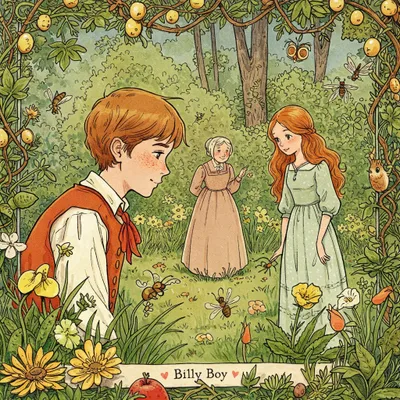
Oh, where have you been,Billy Boy, Billy Boy?Oh, where have you been,Charming Billy?I have been to seek a wife,She’s the joy of my life,She’s a young thingAnd cannot leave her mother.
Did she ask you to come in,Billy Boy, Billy Boy?Did she ask you to come in,Charming Billy?Yes, she asked me to come in,There’s a dimple in her chin.She’s a young thingAnd cannot leave her mother.
Can she make a cherry pie,Billy Boy, Billy Boy?Can she make a cherry pie,Charming Billy?She can make a cherry pie,Quick as a cat can wink an eye,She’s a young thingAnd cannot leave her mother.
How old is she,Billy Boy, Billy Boy?How old is she,Charming Billy?Three times six and four times seven,Twenty-eight and eleven,She’s a young thingAnd cannot leave her mother.
History and Meaning
"Billy Boy" is a traditional English folk song and nursery rhyme that has been sung in various forms since the late eighteenth century. Structured as a humorous question-and-answer dialogue between a mother and her courting son, the song is well-known for its catchphrase about baking a cherry pie.
The song was widely adapted as a sea shanty and minstrel show performance throughout the nineteenth century.
Origins
The song is registered in the Roud Folk Song Index as number 326. While its exact authorship is anonymous, the song's written history dates back to Scotland. A closely related set of verses was recorded in the Herd manuscript in 1776, and the song was first printed in 1791 under the title "My Boy Tammy," with lyrics written by Hector MacNeill. It was published in Johnson's Scots Musical Museum in 1797. The popular English nursery rhyme version was later compiled by classical composer Ralph Vaughan Williams, who published it in his school songbooks in 1912.
Meaning & Interpretation
The lyrics are a lighthearted parody of the traditional, tragic Scottish ballad "Lord Randal." In "Lord Randal," a young man returns home to his mother after being poisoned by his sweetheart. In contrast, "Billy Boy" features a mother questioning her son about his search for a wife, receiving comic replies about her domestic skills and age. For example, Billy's lover can make a cherry pie "quick as a cat can wink an eye," but she is too young to leave her mother. The riddle about her age (three times six and four times seven, twenty-eight and eleven) piles up contradictory numbers on purpose, the joke being that she sounds far too old to still be the "young thing" who cannot leave her mother.
What is the history of the song Billy Boy?
The song began as a traditional Scottish folk song in the late eighteenth century, first published as "My Boy Tammy" in 1791. It evolved into a popular nursery rhyme in England and the United States, and was famously collected by composer Ralph Vaughan Williams in 1912.
Is Billy Boy related to Lord Randal?
Yes, "Billy Boy" is a comic parody of the tragic medieval ballad "Lord Randal." While the older ballad details the poisoning and death of a young man, "Billy Boy" replicates the mother-son question-and-answer format to deliver a humorous courtship story.
Music Video
If the player is unavailable, watch this video on YouTube.
Lyrics from nurseryrhymes.info