

Go In and Out the Window


Lyrics
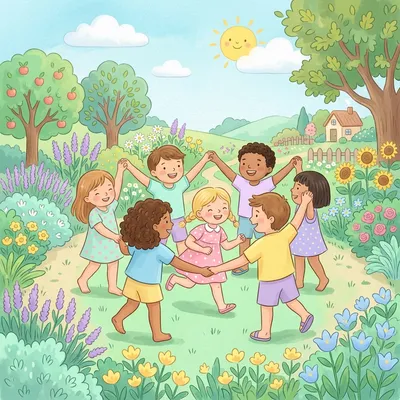
The children join hands in a ring and raise their arms to make arches. One child stands outside the circle.
Go in and out the window,Go in and out the window,Go in and out the window,As we have done before.
The single child weaves through the arches, in one and out the next, all the way round the ring.
Go forth and face your partner,Go forth and face your partner,Go forth and face your partner,As we have done before.
The weaver stops in front of one player and stands facing them. The ring lowers its arms.
I kneel because I love you,I kneel because I love you,I kneel because I love you,As we have done before.
The weaver kneels on one knee in front of the chosen child.
I measure my love to show you,I measure my love to show you,I measure my love to show you,As we have done before.
The weaver stands and holds a flat hand up beside the other child's head, as if measuring their height.
Now follow me to London,Now follow me to London,Now follow me to London,As we have done before.
The chosen child leaves the ring and follows the weaver. The ring closes the gap, raises its arms, and the game begins again.
History and Meaning
A ring of children with hands joined and arms lifted high, and one child threading through the gaps: that is the entire game. The raised arms are the windows. William Wells Newell printed it in Games and Songs of American Children in 1883, and it has stayed in circulation ever since, mostly because it needs no equipment, no field markings and no explanation beyond pointing at the arches.
It also works with any number of players above about six, which is why it turns up in preschool rooms, church halls and playgrounds without anyone having to teach it formally. Children who have seen it once can run it themselves.
Origins
Newell published Games and Songs of American Children with Harper and Brothers in 1883. The book gathered around 190 games with their tunes, rules and movements, collected partly from children he watched and questioned directly and partly from adults recalling what they had played in their own childhoods. It was the first systematic attempt to record American children's play as folklore rather than as a curiosity, and a revised second edition followed in 1903.
Newell was not a casual hobbyist. In 1888 he helped found the American Folklore Society and became the first editor of the Journal of American Folklore, the position he held while the discipline was taking shape in the United States. His interest in ring games was scholarly: he argued that children's play preserved older adult customs in miniature, and he compared American versions against English and European ones throughout the book.
The game has close English relatives, most obviously the ring game usually called "Round and Round the Village", which uses the same window-weaving move. Verses vary a great deal by region. Some versions run only two stanzas, going from the window straight to choosing a partner. Others add the kneeling, the measuring and the walk to London. The wording of the chorus line shifts too, between "as we have done before" and "as you have done before". Older printings often use "lover" where modern classrooms sing "partner".
The endings differ just as much. In some versions the chosen child simply replaces the weaver in the middle. In others the two hold hands and weave together, so the line grows longer each round until the ring is used up. Neither is more correct than the other; pick one before you start and tell the children which it is.
Meaning & Interpretation
The later verses are courtship gestures scaled down for children. Kneeling, measuring, and following someone to London are all borrowed from adult wooing and wedding play, which is exactly the pattern Newell was pointing at when he treated singing games as survivals of older custom. Children playing it do not read any of that. For them the meaning is entirely mechanical: get through the arches without knocking anyone's arms down, and pick someone good at the end.
Folklorists often use this game as the reference point for the whole window-weaving family, since the structure is stripped down to its simplest form here. Once you know it, you can see the same skeleton in a lot of other games, including Bluebird, Bluebird, which swaps the window verse for a bird flying through the arches and replaces the courtship ending with a tap on the shoulder.
How do you play Go In and Out the Window?
Children stand in a circle holding hands, then raise their joined hands to shoulder height or higher to make a series of arches. One child is chosen to start outside the ring. As the group sings the first verse, that child weaves through the arches, passing under one pair of arms and back out through the next, working all the way around the circle. On the second verse the weaver stops in front of one player and faces them, and the ring lowers its arms. The following verses cue the actions in order: kneel on one knee, stand and hold a hand up to measure the other child's height, then lead them out of the ring. The chosen child becomes the new weaver, or joins the first weaver for the next round, depending on which ending you are using. Play until everyone has had a turn.
Who was William Wells Newell?
Newell, who lived from 1839 to 1907, was an American folklorist and a Harvard graduate who trained at Harvard Divinity School before working as a minister and a tutor. He collected children's games and songs across the United States and published them as Games and Songs of American Children in 1883, the first collection of its kind in America. In 1888 he was among the founders of the American Folklore Society and became the first editor of its Journal of American Folklore.
How many verses does Go In and Out the Window have?
There is no fixed number. Five is common in American classrooms, covering the window, the partner, the kneeling, the measuring and the walk to London, but printed and remembered versions run anywhere from two verses to seven. Because each verse simply cues one action, teachers add or cut them freely to fit the length of the session or the patience of the group.
What are the "windows" in the song?
They are the arches made by the children's raised, joined arms. Each pair of players holding hands overhead forms one window, and the weaving child passes through them in turn. Nothing physical is set up for the game; the ring itself is the row of windows.
Related Nursery Rhymes





Lyrics from nurseryrhymes.info