

I've Been Working on the Railroad
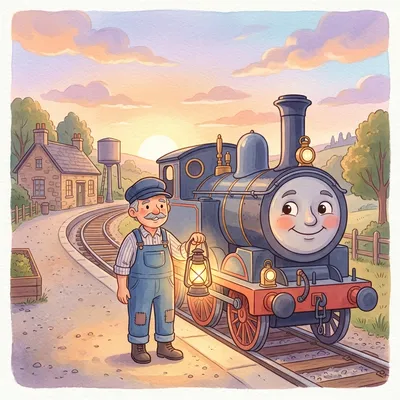


Lyrics
I've been working on the railroad,All the livelong day.I've been working on the railroad,Just to pass the time away.Can't you hear the whistle blowing?Rise up so early in the morn.Can't you hear the captain shouting,"Dinah, blow your horn!"
Dinah, won't you blow,Dinah, won't you blow,Dinah, won't you blow your horn?Dinah, won't you blow,Dinah, won't you blow,Dinah, won't you blow your horn?
Someone's in the kitchen with Dinah,Someone's in the kitchen I know.Someone's in the kitchen with Dinah,Strumming on the old banjo.
Fee, fie, fiddly-i-o,Fee, fie, fiddly-i-o-o-o-o,Fee, fie, fiddly-i-o,Strumming on the old banjo.
History and Meaning
The song reached print in 1894 as "Levee Song", one number in Carmina Princetonia, the Princeton University songbook. It was a college glee club piece before it was ever a children's song, and the version sung in classrooms today is really two or three older songs stitched end to end. That patchwork is why the mood changes so sharply partway through, and it explains how the opening tune ended up as the official song of a university in Texas.
Origins
The 1894 printing is the earliest known appearance. Its title points at levees rather than rail lines: a levee is the raised bank that holds a river back from the land beside it, and levee work meant loading and unloading riverboat cargo along the Mississippi. Glee clubs did most of the work of spreading it. Touring student singers carried campus songbooks from town to town in the 1890s, and the piece travelled well because the chorus is easy to join without knowing the verse.
The "Someone's in the kitchen with Dinah" section arrived from somewhere else entirely. It circulated on its own as "Old Joe, or Somebody in the House with Dinah", printed in London in the 1830s or 1840s with music credited to J. H. Cave, and was attached to the railroad verse later. Some writers connect the "Fee, fie, fiddly-i-o" refrain to "Goodnight, Ladies", which E. P. Christy published as "Farewell Ladies" in 1847, though that is a family resemblance rather than a documented borrowing. Even the opening melody has drawn comparison to the cello solo in Franz von Suppé's 1846 overture Poet and Peasant.
The earliest known commercial recording was cut by the Shannon Quartet for Victor in 1923.
One part of the history is worth stating plainly. The 1894 text and the earlier printings behind it come out of the minstrel stage, and they carry the dialect spellings and racial conventions of nineteenth-century blackface performance. Modern songbooks print plain standard English and have dropped that material completely, so the words children sing now are not the words of 1894.
Meaning & Interpretation
The opening is a complaint wearing the costume of a work song. The singer has been at it all the livelong day, up before dawn, with a whistle blowing and a captain shouting orders. "Livelong" is an old intensifier meaning the whole weary length of something, so the livelong day is a day that will not end.
Dinah's horn is generally read as the signal that punctuates the working day, the blast that calls the crew in. The kitchen section then turns the picture around. While the singer is out on the line, somebody else is indoors with Dinah, strumming a banjo and doing no work at all. Sung one after the other, the two halves make a small joke about who is doing the work and who is not, and children usually enjoy the second half more because the nonsense syllables are easier and louder.
Is it the same tune as The Eyes of Texas?
Yes. In 1903 the University of Texas student John Lang Sinclair wrote new words to the melody of the opening section at the request of bandmate Lewis Johnson. "The Eyes of Texas" was first performed on 12 May 1903 at the Hancock Opera House in Austin and became the university's official song. Sing the first line of either and the other one fits.
Who is Dinah?
Dinah is not a specific person. The name was used generically in nineteenth-century American popular song for an African American woman, and it arrived in this song already attached to the older "Somebody in the House with Dinah". Modern singers treat her simply as the person with the horn.
Why does the song change halfway through?
Because it is a composite. The railroad verse and the "Someone's in the kitchen with Dinah" section began as separate songs written decades apart, and the join is still audible in the shift of rhythm and subject.
What does "the livelong day" mean?
It means the entire day, from beginning to end, with a suggestion that it felt long. The phrase is much older than the song and survives today mostly in this one line.
Related Nursery Rhymes





Lyrics from nurseryrhymes.info