
Down by the Station


Lyrics
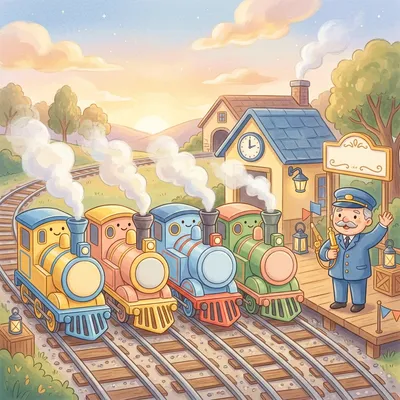
Down by the station, early in the morning,See the little pufferbellies all in a row.See the station master turn the little handle,Puff, puff, toot, toot, off we go!
History and Meaning
A pufferbelly is a steam locomotive. That single fact clears up most of the confusion this song causes, because the word has been out of everyday use for the best part of a century and almost no child singing it today has ever seen the machine it describes. The name is informal old railway slang, built from the puffing of steam out of the stack and the fat rounded belly of the boiler sitting along the engine's length. Say it out loud and the word does most of the explaining by itself.
The scene is a rail yard at the start of the working day. The engines are lined up in a row, steam already up, waiting to be sent out. Someone turns a handle, the whistle sounds, and they move off. Four lines, one small picture, and a burst of noise at the end that toddlers will happily repeat until an adult gives in.
Origins
The lyrics first appeared in print in 1931, in the annual edition of Recreation, the magazine of the American National Recreation Association, where they were published anonymously under the title "The Pufferbelly Song". No author was named then and none has been established since, which places the verse among the many playground and camp songs that circulated by ear for years before anyone thought to write them down.
The song reached a wide audience in 1948, when Lee Ricks and Slim Gaillard recorded a version and Tommy Dorsey's band made it a hit. Those 1948 arrangements added extra verses of their own. The four lines above are the older traditional text and the only part that children generally sing.
The melody belongs to a family of children's tunes rather than to one composer. Its opening phrase runs close to the chorus of "Alouette", the French Canadian folk song, and the same rising, stepping shape turns up in "The Itsy Bitsy Spider" and "Little Bunny Foo Foo". Whether "Down by the Station" borrowed from "Alouette" or both drew on a common melodic pattern is not something anyone has proved.
Meaning & Interpretation
There is no lesson in this one and no story beyond the departure. What it offers instead is a sequence of events a small child can follow: the engines are waiting, the station master acts, the engines leave. That structure is why the song holds attention. The final line rewards the child for sitting through the first three.
The handle is never identified. In practice it stands in for whatever the man in charge does to set a train moving, and the vagueness has never bothered anyone. The important detail is that a person makes the decision and the machine obeys.
What is a pufferbelly?
A pufferbelly is an informal, now dated term for a steam locomotive. It comes from "puffer", for the sound of steam escaping in rhythmic bursts as the engine works, and "belly", for the broad cylindrical boiler that forms the body of the engine. It was casual railway and general slang rather than a technical designation, and it fell out of use as steam engines disappeared from the railways during the middle of the twentieth century.
Who wrote Down by the Station?
Nobody knows. The verse was printed anonymously in Recreation magazine in 1931 as "The Pufferbelly Song", with no author credited, and no earlier printed source has been found. The additional verses many people know from recordings date from 1948 and are the work of later songwriters, not part of the traditional rhyme.
Is Down by the Station the same tune as Alouette?
Not the same, but clearly related. The first line of "Down by the Station" follows a melodic shape very close to the chorus of "Alouette", the French Canadian folk song, and singers often notice the resemblance immediately. The two songs then go their separate ways. That same stepping pattern also underlies "The Itsy Bitsy Spider", so the tune is best described as one member of a shared family rather than a straight borrowing.
How do you use Down by the Station as an action song?
Rotate both fists in front of you like driving wheels while singing the first three lines, then on "puff, puff" push the fists forward twice and on "toot, toot" pull an imaginary whistle cord overhead. Toddler groups often finish by shuffling round the room in a line, each child holding the shoulders of the one in front. The rhythm is steady and slow enough for very young children to keep up with, which is why it survives in nurseries long after real pufferbellies stopped running.
Related Nursery Rhymes





Lyrics from nurseryrhymes.info