

Down by the Riverside



Lyrics
Gonna lay down my sword and shield,Down by the riverside,Down by the riverside,Down by the riverside.Gonna lay down my sword and shield,Down by the riverside,Gonna study war no more.
I ain't gonna study war no more,I ain't gonna study war no more,I ain't gonna study war no more.I ain't gonna study war no more,I ain't gonna study war no more,I ain't gonna study war no more.
Gonna lay down my heavy load,Down by the riverside,Down by the riverside,Down by the riverside.Gonna lay down my heavy load,Down by the riverside,Gonna study war no more.
Gonna put on my long white robe,Down by the riverside,Down by the riverside,Down by the riverside.Gonna put on my long white robe,Down by the riverside,Gonna study war no more.
Gonna shake hands around the world,Down by the riverside,Down by the riverside,Down by the riverside.Gonna shake hands around the world,Down by the riverside,Gonna study war no more.
History and Meaning
The refrain is a promise to stop: "I ain't gonna study war no more." African Americans held in slavery in the American South were singing "Down by the Riverside" before the Civil War, but nobody printed it until 1918. In the hundred years since, it has moved from church meetings to marches, and it is now one of the most widely sung peace songs in the United States.
Children pick it up quickly because of its shape. One singer calls out the new line, everybody answers "down by the riverside", and the answer never changes. That leaves only a handful of words to learn per verse, and it means a group can add verses on the spot without anyone getting lost.
Origins
The song comes out of the oral tradition of enslaved African Americans in the South, where it was sung both as a spiritual and as a work song. Because that tradition was carried by voice rather than by print, there is no first author and no first date, only the point at which collectors began writing it down. That happened in 1918, when it appeared in Plantation Melodies: A Collection of Modern, Popular and Old-time Negro-Songs of the Southland, published in Chicago by the Rodeheaver Company.
Recordings followed quickly. The Fisk University jubilee quartet recorded it in 1920, and Columbia issued the record in 1922. More than a dozen Black gospel recordings were made before the Second World War. The song travels under several titles, including "Ain't Gonna Study War No More" and "Gonna Lay Down My Burden", and verses vary from one songbook and one congregation to the next.
Its second life began in the twentieth century. During the civil rights movement of the 1950s and 1960s it was sung as a freedom song at mass meetings and demonstrations, where a hymn about refusing to fight suited a campaign built on nonviolence. Later, its pacifist imagery made it a standard at anti-war gatherings, particularly during the Vietnam War, and it stayed in the protest repertoire from there.
Meaning & Interpretation
Every verse is an action, and most of the actions are about putting something down. The sword and shield go first. Then the heavy load, then the white robe goes on, then hands are shaken around the world. The singer is not describing a battle. The singer is describing walking away from one and arriving somewhere clean.
The opening image of laying down weapons is generally read as an echo of Isaiah 2:4, the passage about beating swords into ploughshares, which in the King James Version ends "neither shall they learn war any more". The wording of the spiritual is close enough that most commentators treat the connection as deliberate, though as with any oral song this is an interpretation rather than a documented borrowing.
The river carries two senses at once. Baptisms were commonly held in real rivers, so the riverside is a literal place where a person is washed and changed. Spirituals also use river crossings, especially the Jordan, as a figure for passing from bondage into freedom or from this life into the next. Singers have long heard both meanings together, and the song does not ask anyone to choose.
What does "study war no more" mean?
"Study" here is an older English use of the word meaning to practise, train for, or prepare yourself in something. To study war is to drill for it and keep yourself ready to fight. So "I ain't gonna study war no more" is not about reading history books. It means the singer will stop training for war altogether, which is a stronger promise than simply refusing one particular battle.
Where does "lay down my sword and shield" come from?
The phrase draws on biblical imagery about the end of warfare, most often linked to Isaiah 2:4, where weapons are reforged into farming tools and nations stop learning war. Spirituals frequently reworked scripture into first-person lines like this one, turning a prophecy about all nations into something a single person could sing about their own life.
Which river is the riverside?
No specific river is named, and none is meant to be. Rivers were where baptisms took place, so the riverside is the place of washing and starting over. Many listeners also hear the crossing imagery common in spirituals, where a river marks the boundary between captivity and freedom. Both readings are interpretation; the lyric itself simply says "the riverside".
Was Down by the Riverside a civil rights song?
Yes. It was one of the spirituals adopted as a freedom song during the civil rights movement of the 1950s and 1960s, sung at meetings and on marches, where its refusal of violence matched the movement's nonviolent method. It was also widely sung at anti-war demonstrations during the Vietnam War, and it remains a common choice at peace gatherings today.
Related Nursery Rhymes
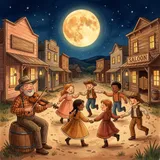





Lyrics from nurseryrhymes.info