

Boats Sail on the Rivers


Lyrics
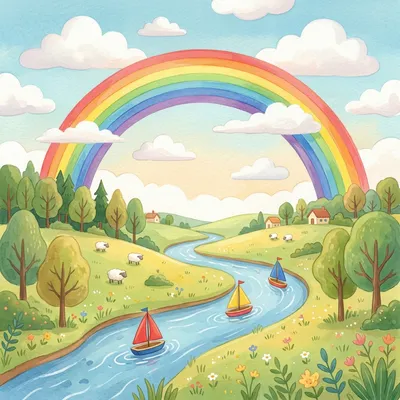
Boats sail on the rivers,And ships sail on the seas;But clouds that sail across the skyAre prettier far than these.
There are bridges on the rivers,As pretty as you please;But the bow that bridges heaven,And overtops the trees,And builds a road from earth to sky,Is prettier far than these.
History and Meaning
Almost every nursery rhyme is anonymous. This one has a named author of the first rank. Christina Rossetti wrote "Boats sail on the rivers" for Sing-Song: A Nursery Rhyme Book, published in London in 1872, when she was already one of the most admired poets in England. Ten lines, two stanzas, and a single move performed twice.
The move is a ranking. Boats and ships come first, and clouds beat them. River bridges come next, and the rainbow beats those. Each stanza names something a small child has genuinely seen, then produces something better, and the phrase "prettier far than these" arrives at the end of both to settle the argument. It is easy to read straight past, because the poem is over in about fifteen seconds.
Origins
Christina Rossetti (1830 to 1894) was the sister of the painter Dante Gabriel Rossetti and the author of Goblin Market (1862). She drafted most of the Sing-Song verses in 1869 and the book appeared from George Routledge and Sons in 1872, with one hundred and twenty illustrations by Arthur Hughes, engraved by the brothers Dalziel.
What makes Sing-Song unusual is that Rossetti wrote the whole thing herself. The famous nursery collections of the period were edited, not composed: an editor gathered traditional verses that had been passed around for a century or more and printed them under a title like Mother Goose. Rossetti instead sat down and produced an entire book of new rhymes in nursery metre, pitched at very young children, using the plainest vocabulary she could manage.
The poems in Sing-Song carry no titles. Readers cite them by their first lines, which is why this one is known as "Boats sail on the rivers" rather than by any name Rossetti gave it. Two more from the same book are on this site: Mix a Pancake and Who Has Seen the Wind?. Her Christmas poem In the Bleak Midwinter, later set to music as a carol, dates from the same stretch of her working life.
Meaning & Interpretation
The poem climbs. Stanza one starts on a river, widens to the sea, then lifts to the sky, and the clouds that "sail" up there borrow the boats' own verb so the comparison stays fair. Stanza two repeats the shape on land. A bridge crosses a river; the rainbow crosses heaven, "overtops the trees", and reaches further than any bridge a builder could put up.
"Bow" is simply the older English word for a rainbow, meaning an arch or a curve, the same bow you find in Genesis 9 and inside the word rainbow itself. Rossetti uses it to make the arch feel structural, something built rather than something that merely appears. The last comparison goes further still: the rainbow "builds a road from earth to sky". A road implies travel, and the poem stops right there without saying who might use it.
There is no lesson attached. Rossetti wrote a great deal of devotional verse, and a religious reader can hear the covenant rainbow behind these lines, but nothing in the poem insists on it. A child gets a small ordered list of pretty things with the best one last, which is enough.
Who wrote Boats Sail on the Rivers?
Christina Rossetti, the English poet, wrote it for Sing-Song: A Nursery Rhyme Book in 1872. She is best known for the long narrative poem Goblin Market and for the words of "In the Bleak Midwinter". Sing-Song was her only book written specifically for small children, and every rhyme in it is her own composition rather than a traditional verse she collected.
What is "the bow that bridges heaven"?
It is a rainbow. Sunlight entering a raindrop bends, reflects off the inside of the back of the drop, and bends again on the way out, and because each colour bends by a slightly different amount the light leaves the drop spread into a band. A rainbow always appears in the part of the sky opposite the sun, so you see one with the sun behind you and rain in front of you. It is not a solid object standing in one place. Each person sees a rainbow made by different drops, which is why you can never walk up to it or find its end.
Why is this poem sometimes called something else?
Because Rossetti left the Sing-Song poems untitled, editors and anthologists supply their own headings. You will see this one printed as "Boats Sail on the Rivers", "The Rainbow", or occasionally "Boats and Bridges". They are all the same ten lines, and the first line is the only label that goes back to the original book.
Related Nursery Rhymes


Lyrics from nurseryrhymes.info