
Mix a Pancake


Lyrics
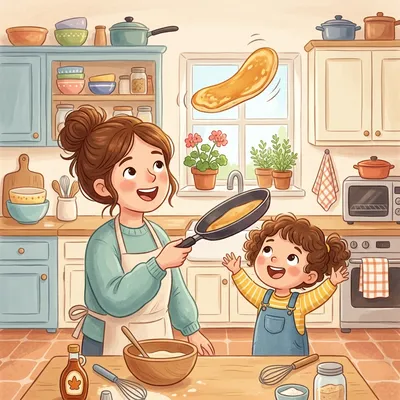
Mix a pancake,Stir a pancake,Pop it in the pan;Fry the pancake,Toss the pancake,Catch it if you can.
Mix: stir one finger round and round in your open palm.Stir: keep stirring, a little faster now.Pop it in the pan: tip the batter from one hand into the other.Fry: hold your flat hand still and let it sizzle.Toss: throw the pancake up with both hands.Catch it if you can: clap it back down, or miss and let it land on your head.
History and Meaning
Six lines, six verbs, and every one of them is something a child can do with their hands. Mix, stir, pop, fry, toss, catch. That is the whole poem, and it is the reason it has stayed in nursery use for more than 150 years while longer and grander Victorian children's verse has fallen away.
The other unusual thing about it is the credit line. Christina Rossetti wrote it. Most of what gets sung in a nursery is anonymous, worn smooth by a few centuries of repetition, with no author anyone can name. This one came out of a single writer's notebook in the early 1870s, and that writer was one of the finest poets in Victorian England.
Origins
The poem first appeared in Sing-Song: A Nursery Rhyme Book, published by George Routledge and Sons in 1872 with 120 illustrations by Arthur Hughes, engraved by the Dalziel brothers. Rossetti was already established by then. Her long poem "Goblin Market" had appeared in 1862 and made her reputation among adult readers. Sing-Song was a deliberate turn towards the very young, and she wrote the entire book herself rather than collecting existing folk rhymes.
The poems in Sing-Song carry no titles. Each is known by its first line, which is why this one is filed under "Mix a Pancake" in modern anthologies without ever having been called that by its author. An enlarged edition in 1893 added several more poems to the original set.
Two other pieces from the same book are on this site: Boats Sail on the Rivers and Who Has Seen the Wind?. Reading the three together shows how wide Rossetti's range was inside one small book. One is a riddle about the invisible, one is a quiet comparison of rivers and rainbows, and this one is a kitchen game.
Meaning & Interpretation
There is no hidden meaning here, and looking for one misses what Rossetti was doing. The poem is a recipe turned into a set of instructions for a body. Each line begins with an imperative verb, so the child is not being told a story about pancakes but ordered to make one, in mime, right now.
The structure is tighter than it looks. Lines one and two pair up, lines four and five pair up, and the only two lines that break the pattern are the third and sixth, which are also the only two that rhyme: "pan" and "can". Those are the lines where something can go wrong. Getting the batter into the pan and catching the pancake after the toss are the risky moments in real pancake making, and the poem puts them exactly where the rhyme lands.
"Catch it if you can" is a dare, and a small joke. Half the fun of the rhyme with a toddler is deliberately failing to catch it.
What actions go with Mix a Pancake?
Stir a finger round in your open palm for "mix" and "stir", tip one hand into the other for "pop it in the pan", hold a flat hand still while it fries, throw both hands upward for the toss, then clap them together to catch. The catch is the punchline, so let it fail sometimes. Older children can do the whole sequence standing with an imaginary frying pan held in two hands.
What is Pancake Day?
Pancake Day is the popular name for Shrove Tuesday, the day before Ash Wednesday and the start of Lent. Lent was traditionally a fasting period of 40 days before Easter, so households used up the eggs, butter and fat in the house on the last day before it began, and pancakes were the efficient way to do that. "Shrove" comes from "shrive", meaning to hear confession and absolve, which is what people did on that day. Pancake races are still run in British towns each year, the best known at Olney in Buckinghamshire, where local tradition dates the custom to 1445.
Did Christina Rossetti write other nursery rhymes?
Yes, more than a hundred. Sing-Song was conceived as a complete nursery collection rather than a handful of children's pieces tucked into an adult volume. It ranges from counting rhymes and animal verses to poems about weather, the seasons and, more often than most modern editions keep, the death of infants. Victorian nurseries were closer to that subject than ours are, and Rossetti did not write around it.
Related Nursery Rhymes



Lyrics from nurseryrhymes.info