
Lazy Mary, Will You Get Up
Lyrics
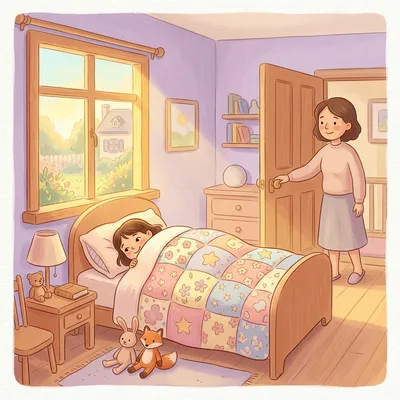
Lazy Mary, will you get up,Will you get up, will you get up?Lazy Mary, will you get up,Will you get up today?
No, no, mother, I won't get up,I won't get up, I won't get up.No, no, mother, I won't get up,I won't get up today.
What will you give me for my breakfast,For my breakfast, for my breakfast?What will you give me for my breakfast,If I get up today?
A slice of bread and a cup of tea,A cup of tea, a cup of tea.A slice of bread and a cup of tea,If you get up today.
No, no, mother, I won't get up,I won't get up, I won't get up.No, no, mother, I won't get up,I won't get up today.
What will you give me if I get up,If I get up, if I get up?What will you give me if I get up,If I get up today?
A nice young man with rosy cheeks,With rosy cheeks, with rosy cheeks.A nice young man with rosy cheeks,If you get up today.
Yes, yes, mother, I will get up,I will get up, I will get up.Yes, yes, mother, I will get up,I will get up today.
History and Meaning
"Lazy Mary" is an argument set to music. One singer plays the mother and calls Mary out of bed. The other plays Mary and flatly refuses. Neither gives ground, so the mother starts bidding: breakfast first, then something better, until Mary decides the offer is worth the effort of standing up. The joke is that she was never too tired. She was holding out for a better deal.
That structure is the reason the song has lasted. Most nursery rhymes are one voice. This one has two, and it splits a room of children cleanly down the middle without any explanation from an adult.
Origins
The song has no known author and no single date. It is a set of words fitted to a tune that was already in wide use, which is the usual way children's singing games are built. The melody is the one shared with "Here We Go Round the Mulberry Bush" (Roud 7882) and "Here We Come Gathering Nuts in May". James Orchard Halliwell recorded that circle game in England in the middle of the nineteenth century, and the tune itself is generally traced further back to a dance popular in London in the 1760s associated with the dancer Nancy Dawson.
"Lazy Mary" belongs to a wider family of comic dialogue songs in English tradition in which someone refuses to get out of bed or refuses to work, and is coaxed, bribed, or mocked into it. Songs about the lazy wife or lazy housewife circulated among adults long before this nursery version existed, and the bargaining shape here clearly comes out of that stock. No specific parent song has been documented as the direct ancestor, and anyone who names one is guessing. The safest description is that "Lazy Mary" is a children's simplification of an old comic idea rather than a shortened version of any one identified ballad.
Versions collected on both sides of the Atlantic differ mainly in the bribe. Some end with bread and milk, some with bread and tea, some with a full breakfast. Others skip food entirely and go straight to the young man. Older adult and music-hall versions of the same joke could be much more pointed about what exactly was on offer, and modern singers have quietly dropped those endings.
Meaning & Interpretation
On the surface it is a song about a teenager and a morning. The comedy sits in Mary's negotiating position. She is not asleep, because she answers every single time, and she knows her mother will keep raising the offer as long as she keeps saying no.
The switch from food to a suitor is the part that changes most between versions, and it dates the song. In a household where a daughter's marriage prospects mattered, "a nice young man with rosy cheeks" was the strongest card the mother had. Sung today it usually lands as a simple punchline about vanity rather than anything more loaded, and plenty of singers replace it with pancakes, a trip to the park, or a birthday.
Sung slowly it is a grumble. Sung fast, with two groups shouting alternate verses, it turns into a contest.
How do you sing Lazy Mary as a call and answer?
Split the singers into two groups. One group takes every verse that begins "Lazy Mary" or names a reward, and the other takes every verse beginning "No, no, mother" or "Yes, yes, mother". Each verse uses the same tune, so no one has to learn a separate part. In the traditional circle game one child lies in the middle as Mary, another stands over her as the mother, and the ring sings around them until Mary agrees to get up. Then two new children take the roles and it starts again.
What tune is Lazy Mary sung to?
The same tune as "Here We Go Round the Mulberry Bush". "Here We Come Gathering Nuts in May" uses it too, and a variant carries "The Wheels on the Bus". If a child already knows any of those, they can sing "Lazy Mary" immediately without being taught the melody.
Why does the ending change so much between versions?
Because the bribe is the only part of the song that has to make sense to the singer. The call and the refusal are fixed, and everything between them is a slot that each family, school, or songbook fills with whatever Mary would plausibly get out of bed for. That is why one recording ends with a piece of bread and a glass of milk and another ends with a young man, without either being wrong.
Is this the same song as Lou Monte's "Lazy Mary"?
No. Lou Monte's "Lazy Mary (Luna Mezzo Mare)" was a 1958 hit that reached number 12 in the United States, and it is an English adaptation of the Sicilian song "C'è la luna mezzo mare", first recorded in 1927. It happens to be another mother and daughter dialogue, but the daughter there is asking to be married off, the suitors are compared through double meanings, and it is a wedding tarantella for adults rather than a nursery song. The shared title is a coincidence.
Related Nursery Rhymes



Lyrics from nurseryrhymes.info