
Jelly on a Plate
Lyrics
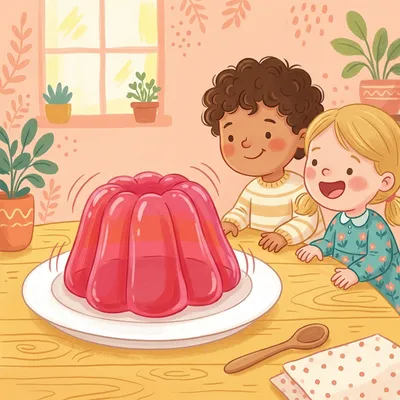
Jelly on a plate,Jelly on a plate,Wibble wobble, wibble wobble,Jelly on a plate.
Sausages in a pan,Sausages in a pan,Sizzle sizzle, pop pop,Sausages in a pan.
Candles on a cake,Candles on a cake,Blow them out, blow them out,Candles on a cake.
Baby on the floor,Baby on the floor,Pick him up, pick him up,Baby on the floor.
History and Meaning
Three of the four lines are the same line. Everything the rhyme has to offer sits in the third one, where the jelly wobbles and so does everybody singing about it. That is the whole design: a fixed frame, a silly noise in the middle, and a physical joke that a one-year-old can get on the first hearing.
It has two lives. The older one is on the playground with a long rope, where the turners flap the rope up and down on "wibble wobble" while the skipper tries to keep going. The newer one, and by far the more common now, is on the carpet at a baby and toddler group, where the child wobbles from head to toe like a bowl of jelly carried across a room too fast. Nurseries in Britain sing it several times a week.
Origins
"Jelly on a Plate" is a well-established British children's rhyme whose first printing is not documented. That is normal for playground material rather than suspicious. Skipping and clapping rhymes were passed from child to child in the street and the schoolyard, and collectors only began writing them down long after they were in circulation, so a rhyme can be widely known for decades before anybody prints it.
What the words themselves suggest is a British domestic scene: jelly at a party, sausages in a frying pan, candles on a birthday cake. The rhyme is also familiar in Ireland, Australia, New Zealand and other places where British playground songs travelled, and in each of them the jelly means the same wobbly dessert it means in London.
The skipping use is the one that explains the shape. Rope games need a rhyme with a strong beat and a moment of difficulty, and "wibble wobble" is both. On those two words the turners shake the rope sideways or bounce it, and the skipper has to ride out the change. Miss a jump and you are out, and the next child steps in. Once the rhyme left the rope and moved indoors to much younger children, the difficulty disappeared and the wobble became the point rather than the obstacle.
Meaning & Interpretation
There is nothing under the surface here. The rhyme is a list of ordinary things that do something visible, and each verse names the thing twice, does the action, then names it again. Jelly wobbles. Sausages sizzle and split. Candles get blown out. That predictable frame is why it works so well with very young children: after one verse they already know where the fun bit lands, and they can join in on the action line before they can manage any of the words.
Families and nurseries add their own verses on the same pattern, and this is the most useful thing to know about the rhyme. Pick anything with an obvious movement, put it in the first, second and fourth lines, and put the movement in the third. Bells in a tower that ring, ring, ring. Ice cream in a cone that drips. Popcorn in a pot that pops. Children will happily supply their own once they hear two or three, and inventing verses about whatever is on the table is a decent way to stretch a two-minute rhyme into ten.
Is the jelly in this rhyme the same as jam?
No. "Jelly" here is the British word for the wobbly fruit-flavoured gelatin dessert eaten cold at children's parties, sold as Jell-O or gelatin dessert in the United States. It is not a fruit preserve or a spread. The whole rhyme depends on that meaning, because a set jelly turned out onto a plate genuinely shakes when you touch the plate, which is the movement the children are copying.
How do you play Jelly on a Plate as a skipping rhyme?
Two children turn a long rope steadily while a third skips in the middle and everyone chants the verse. On the "wibble wobble" line the turners deliberately wobble the rope, shaking it or bouncing it out of its smooth arc so the rhythm goes unpredictable, and the skipper has to survive it. If the skipper trips or stops, they swap out and take a rope end, and the next child jumps in.
What actions do you do with toddlers?
Stand or sit the child in front of you and wobble your whole body on the "wibble wobble" line, knees loose, shoulders shaking, head included. Younger babies can be gently jiggled on your lap instead. For the other verses, mime the action plainly: clap or jump on "pop" for the sausages, puff out a big breath for the candles, and scoop the child up off the floor for the last one, which usually gets the biggest reaction.
Related Nursery Rhymes



Lyrics from nurseryrhymes.info