
Miss Polly Had a Dolly

Lyrics
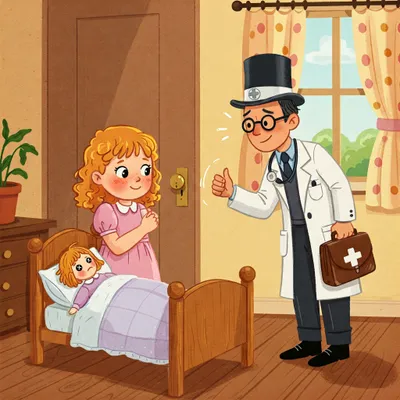
Miss Polly had a dolly who was sick, sick, sick.So she called for the doctor to come quick, quick, quick.The doctor came with his bag and his hat,And he knocked on the door with a rat-a-tat-tat.
He looked at the dolly and he shook his head,And he said "Miss Polly, put her straight to bed!"He wrote on a paper for a pill, pill, pill,"I'll be back in the morning with the bill, bill, bill."
History and Meaning
Miss Polly's doll is sick, so she calls the doctor, who arrives with his bag and hat, knocks rat-a-tat-tat, prescribes a pill, and promises to be back in the morning with the bill. Children act the whole visit out with gestures, which makes a trip to the doctor feel familiar and friendly.
Origins
The precise origins of "Miss Polly Had a Dolly" are unknown. While some twentieth-century sources suggested it arose as an eighteenth-century political satire in England, historical research has found no evidence to support this claim. The song is cataloged under number 16289 in the Roud Folk Song Index. It is widely considered a traditional play-song of British origin, with early versions documented in Scottish folklore. Because it was passed down through oral traditions for decades before appearing in printed collections, there is no verified first publication date or author.
Meaning & Interpretation
The narrative is straightforward, describing a girl named Polly whose doll falls ill. She calls the doctor, who arrives with his bag and hat, examines the doll, and instructs Polly to put her to bed. The doctor writes a prescription for a pill and says he will return in the morning with the bill.
The song is primarily used in early childhood settings as an active role-playing game. Caregivers and teachers encourage children to perform gestures matching the story, such as pretending to rock a doll, dial a phone, knock on a door, or write on paper. This physical movement helps develop motor skills, coordination, and language patterns. The story also helps familiarize toddlers with visiting the doctor in a non-threatening, friendly context.
What does the Miss Polly Had a Dolly song teach?
The song introduces children to concepts of healthcare, empathy, and caring for others. It also provides opportunities to practice motor coordination through matching hand movements.
How do children act out Miss Polly Had a Dolly?
Children perform actions such as rocking a baby, pretending to knock on a door to mimic the doctor's arrival, shaking their heads, writing a prescription, and acting out calling a doctor on a phone.
Music Video
If the player is unavailable, watch this video on YouTube.
Lyrics from nurseryrhymes.info