
The Gartan Mother's Lullaby


Lyrics
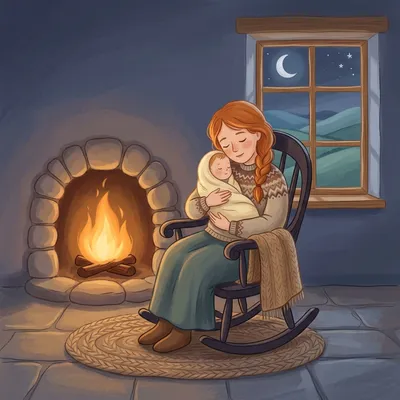
Sleep, O babe, for the red bee hums the silent twilight's fall,Aoibheall from the Grey Rock comes to wrap the world in thrall.A leanbhan o, my child, my joy, my love and heart's desire,The crickets sing you lullaby beside the dying fire.
Dusk is drawn, and the Green Man's Thorn is wreathed in rings of fog,Siabhra sails his boat till morn upon the Starry Bog.A leanbhan o, the paly moon hath brimmed her cusp in dew,And weeps to hear the sad sleep-tune I sing, O love, to you.
History and Meaning
Most lullabies reach us anonymous and undated. This one has a paper trail. Herbert Hughes wrote the air down in north Donegal in August 1903, the poet Joseph Campbell put English words to it, and the two printed the result in a Belfast collection called Songs of Uladh in 1904.
The words are strange for a cradle song. A fairy queen arrives at nightfall to wrap the world in thrall, a sprite sails a boat across a bog full of stars, and the moon weeps at the tune being sung. Singers today often hum past the unfamiliar names without knowing that Aoibheall, siabhra and leanbhan are Irish, and that each one means something quite specific.
Origins
Hughes (1882 to 1937) was a Belfast musician barely out of his teens when he spent August 1903 collecting airs in north Donegal, travelling with his brother Fred, the antiquarian Francis Joseph Bigger, and Campbell. His preface to the book notes that he made the collection while holidaying in north Dun-na-nGall the previous summer. Bigger paid the printing costs. Campbell's brother John illustrated it, signing himself with the Irish form of the family name, and Joseph did the same, appearing on the title page as Seosamh Mac Cathmhaoil. Uladh is simply Irish for Ulster.
The method was consistent: an old tune noted from a country singer, a new English lyric written over it. The same 1904 collection produced "My Lagan Love", which went on to become the better known of the two songs.
Gartan is a civil parish and townland in County Donegal, west of Letterkenny, and is best known in Irish tradition as the birthplace of Colm Cille (Saint Columba). The song itself never mentions the saint. Its third verse, often dropped in performance, names Tearmann (Termon) instead, a village close by, and a chapel bell ringing across the valley at dusk.
Meaning & Interpretation
The setting is a single evening. The fire is dying, crickets have started up, fog is settling on a hawthorn, and a mother is singing her child down into sleep. What makes the song unusual is how it handles the dark. Rather than shutting the night out, it names everything moving in it and keeps each thing at a comfortable distance. The bee hums, the fairy queen comes, the sprite goes off boating on his own business. Nothing in the two verses actually threatens the baby.
"A leanbhan o" is the hinge of each verse. It is an Irish endearment meaning roughly "O little child", and it marks the point where the song turns away from the landscape and back to the cradle.
The mood is not straightforwardly comforting. The moon "weeps to hear the sad sleep-tune", which is an odd thing for a mother to sing about her own singing. Campbell was writing inside the Irish Literary Revival, a movement with a strong appetite for melancholy and for old names recovered and put back into use, and the lullaby carries both.
What do the Irish words in The Gartan Mother's Lullaby mean?
The song keeps several Irish words untranslated. The main ones:
A leanbhan o - roughly "O little child". Leanbhan is an old Irish word for a little child.
Siabhra (pronounced roughly "sheev-ra", often anglicised as sheevra) - a fairy or sprite, usually one of the lesser and more mischievous kind. The notes to Songs of Uladh treat it here as a general word for an Irish fairy rather than a malevolent one.
Aoibheall - a fairy queen of Irish tradition, also written Aibell.
Tearmann - Termon, a village near Gartan, named in the third verse.
Uladh - Ulster, the province the 1904 collection takes its title from.
Who is Aoibheall in the song?
Aoibheall is a fairy queen of Irish tradition whose otherworld home is Craig Liath, the Grey Rock, a hill above Killaloe in County Clare. She was regarded as the guardian spirit of the Dal gCais and their descendants the O'Briens, appears in the older stories to warn Brian Boru of his death before the Battle of Clontarf in 1014, and presides over Brian Merriman's eighteenth-century poem "The Midnight Court". The notes to Songs of Uladh describe her as queen of the northern fairies, which suits the song's Donegal setting rather than the Clare tradition she belongs to elsewhere.
Who wrote The Gartan Mother's Lullaby?
Joseph Campbell (1879 to 1944) wrote the words and Herbert Hughes (1882 to 1937) collected and arranged the melody, which he took down from traditional singing in north Donegal in 1903. They published it together in Songs of Uladh in 1904. That makes it a hybrid rather than a folk song in the usual sense: the tune is genuinely traditional, but the English lyric is the work of a named poet and can be dated to a single year.
Related Nursery Rhymes

Lyrics from nurseryrhymes.info