

I Saw a Ship A-Sailing
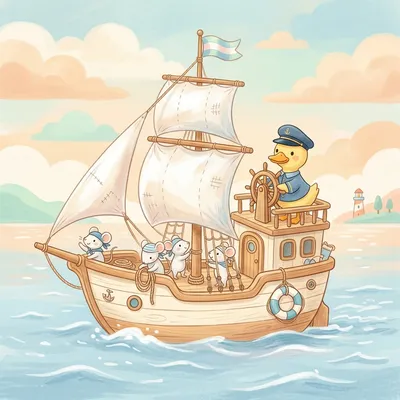


Lyrics
I saw a ship a-sailing,A-sailing on the sea;And, oh! it was all ladenWith pretty things for thee!
There were comfits in the cabin,And apples in the hold;The sails were made of silk,And the masts were made of gold.
The four-and-twenty sailorsThat stood between the decks,Were four-and-twenty white miceWith chains about their necks.
The captain was a duck,With a packet on his back;And when the ship began to move,The captain said, "Quack! Quack!"
History and Meaning
The crew of this ship is twenty-four white mice wearing chains around their necks, and the captain is a duck who gives one order: "Quack! Quack!" Everything else on board is treasure. Silk sails, gold masts, sweets in the cabin, apples in the hold, and the whole cargo is announced as a gift for the listener. The rhyme is a small parade of good things, delivered in four short verses, and it ends on a joke rather than a moral.
That combination of luxury and nonsense is why it works so well at bedtime. The rhythm is a steady rocking ballad metre, the pictures get stranger as the verses go on, and nothing frightening ever happens.
Origins
The earliest confirmed printing is in Walter Crane's The Baby's Bouquet, published in 1878. Crane was one of the leading Victorian illustrators and designers, closely associated with the Arts and Crafts movement, and The Baby's Bouquet was the second of his small square children's songbooks, gathering thirty-seven English, French and German nursery songs with their tunes. His sister Lucy Crane arranged the music, and the colour wood engravings were printed by Edmund Evans.
The rhyme turns up again in 1895 in A Book of Nursery Songs and Rhymes, edited by the antiquarian and hymn writer Sabine Baring-Gould and illustrated by members of the Birmingham Art School. Between them, those two books put the verses firmly into the late Victorian nursery canon.
It is worth being honest about the dating. The rhyme is often described loosely as much older, and some collections imply an eighteenth century chapbook or early Mother Goose origin. No printing before 1878 has been traced. That does not prove the words were invented in the 1870s, since nursery verse circulates by voice long before anyone writes it down, but the evidence on paper starts with Crane and nowhere earlier.
Meaning & Interpretation
There is no hidden meaning here, and the rhyme is better for it. Some nursery verses attract political decoding, usually invented long after the fact. This one has never carried a credible allegory, and nothing in its printing history suggests one. The pleasure is the inventory.
Read the verses as a dream cargo. A child is told that a ship is coming, that it is loaded with pretty things, and that the pretty things are for them. The list escalates: sweets, fruit, then silk, then gold. By the time the sailors appear, the ordinary rules have already been suspended, so mice in chains and a duck at the wheel land as delight rather than confusion. The final "Quack! Quack!" punctures the grandeur on purpose, which is the sort of ending small children find genuinely funny.
The chains about the mice's necks read oddly to modern ears. In the world of the rhyme they are jewellery, matching the silk and the gold, not restraints.
How old is I Saw a Ship A-Sailing?
Its first confirmed appearance in print is 1878, in Walter Crane's songbook The Baby's Bouquet, and it was printed again in 1895 in Sabine Baring-Gould's A Book of Nursery Songs and Rhymes. Despite frequent claims that it is an eighteenth century rhyme, no earlier printed source has been located, so the safe answer is late nineteenth century in print and possibly older in speech.
What are comfits?
Comfits are old-fashioned sweets made by coating a seed, nut or piece of spice in successive layers of hardened sugar, the ancestor of the modern sugared almond and the sprinkles used on cakes. They were a common treat in Victorian Britain, which is why a cabin full of them signals luxury in the rhyme.
Why are there four-and-twenty sailors?
"Four-and-twenty" is simply the older English way of saying twenty-four, with the units spoken before the tens. Nursery rhymes preserved the phrasing long after everyday speech dropped it, and the same count appears in "Sing a Song of Sixpence" with its four-and-twenty blackbirds.
What does the captain carry on his back?
The text says "a packet on his back", meaning a parcel or bundle, which suits a ship carrying goods. Some printings give the line as "a jacket on his back" instead, dressing the duck up as an officer. Both versions are sung, and neither changes the sense of the verse.
Related Nursery Rhymes






Lyrics from nurseryrhymes.info