

Home on the Range


Lyrics
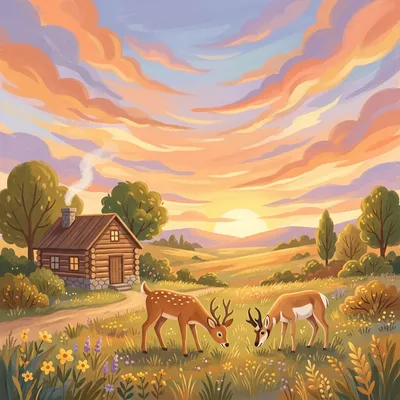
Oh, give me a home where the buffalo roam,Where the deer and the antelope play,Where seldom is heard a discouraging word,And the skies are not cloudy all day.
Chorus
Home, home on the range,Where the deer and the antelope play,Where seldom is heard a discouraging word,And the skies are not cloudy all day.
How often at night when the heavens are brightWith the light from the glittering stars,Have I stood there amazed and asked as I gazedIf their glory exceeds that of ours.
History and Meaning
In 1934 American radio stations stopped playing "Home on the Range". A couple from Tempe, Arizona, William and Mary Goodwin, had sued for half a million dollars, saying the song was theirs and that they had copyrighted it in 1905 under a title of their own. Half a million was an enormous sum in the middle of the Depression. Broadcasters and publishers pulled the song rather than keep racking up a claim, and one of the most familiar tunes in the country went quiet while lawyers worked.
Origins
The Music Publishers Protective Association hired a New York attorney, Samuel Moanfeldt, to find out where the song had actually come from. He went west and worked backwards through the singers who remembered it, and the trail ended in Smith County, Kansas.
There a homesteading doctor named Brewster Higley had written a poem called "My Western Home", describing the land around his cabin on West Beaver Creek. Accounts put the writing in 1872 or 1873, and it appeared in the Smith County Pioneer newspaper in 1873. A neighbour and friend, Daniel E. Kelley, worked out a melody for it on his guitar. Kelley played in the Harlan Brothers Orchestra, and the group performed the song around local dances and gatherings in the 1870s under the name "Western Home". Moanfeldt found Clarence Harlan, still living, who confirmed that his brother-in-law Kelley had set Higley's words to music decades before the Goodwins claimed to have written anything.
That was the end of the case. The Goodwins' claim collapsed, and the investigation that killed it had done something nobody expected: it recovered the authorship of a song everyone had assumed was anonymous. Cowboys and settlers had carried the words across the plains for sixty years, changing lines as they went, until the "buffalo roam" version we sing now had drifted some way from Higley's original text. Kansas made it the official state song on 30 June 1947.
Meaning & Interpretation
The song is a homesteader's description of the place he chose to live, written by a man looking at it. Higley had left Illinois and Indiana after a hard run of family losses, and the poem reads as relief at open country. The buffalo, deer and antelope were things he could see. So were the skies that "are not cloudy all day", which is less a boast than a plain observation about the high plains in dry weather.
"Seldom is heard a discouraging word" is the line people quote most, usually with a smile. On a homestead a hundred miles from much of anything, quiet was not a small thing. Sung slowly, the verse about standing under the glittering stars turns the whole song into a lullaby, which is how it most often reaches children now.
Why was Home on the Range taken off the radio in 1934?
An Arizona couple, William and Mary Goodwin, sued NBC and several music publishers for damages reported at $500,000, claiming they had written and copyrighted the song in 1905. While the case was open, broadcasters and publishers stopped performing it to avoid adding to the claim. The song returned once the defence proved it predated the Goodwins by more than thirty years.
Who really wrote Home on the Range?
Dr Brewster Higley wrote the words as a poem called "My Western Home" in Smith County, Kansas, published in the Smith County Pioneer in 1873. His friend Daniel E. Kelley composed the melody. Neither man copyrighted it, and the song spread as folk music, which is why its authorship had been forgotten by the time the 1934 lawsuit forced someone to go looking.
Can you visit the cabin where Home on the Range was written?
Yes. Higley's log cabin still stands on its original site north of Athol in Smith County, Kansas. It is listed on the National Register of Historic Places, was restored in 2013 to its 1870s appearance, and is open to visitors from daylight to dark.
Is Home on the Range the state song of Kansas?
It is. The Kansas legislature adopted it on 30 June 1947, after the lawsuit investigation had established the song's Kansas origins. A state senator from Smith Center, the county seat nearest Higley's cabin, introduced the bill.
Related Nursery Rhymes



Lyrics from nurseryrhymes.info