
'Twas the Night Before Christmas


Lyrics
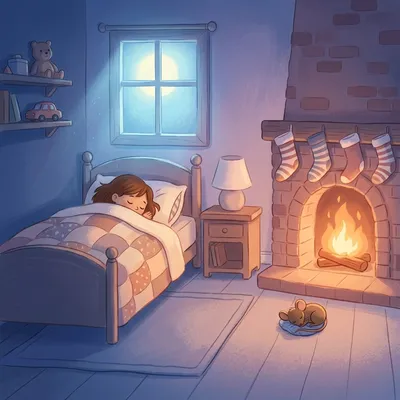
'Twas the night before Christmas, when all thro' the house,Not a creature was stirring, not even a mouse;The stockings were hung by the chimney with care,In hopes that St. Nicholas soon would be there;The children were nestled all snug in their beds,While visions of sugar plums danc'd in their heads,And Mama in her 'kerchief, and I in my cap,Had just settled our brains for a long winter's nap,When out on the lawn there arose such a clatter,I sprung from the bed to see what was the matter,Away to the window I flew like a flash,Tore open the shutters, and threw up the sash.The moon on the breast of the new fallen snow,Gave the lustre of mid-day to objects below;When, what to my wondering eyes should appear,But a miniature sleigh, and eight tiny rein-deer,With a little old driver, so lively and quick,I knew in a moment it must be St. Nick.More rapid than eagles his coursers they came,And he whistled, and shouted, and call'd them by name:"Now! Dasher, now! Dancer, now! Prancer, and Vixen,"On! Comet, on! Cupid, on! Dunder and Blixem;"To the top of the porch! to the top of the wall!"Now dash away! dash away! dash away all!"As dry leaves before the wild hurricane fly,When they meet with an obstacle, mount to the sky;So up to the house-top the coursers they flew,With the sleigh full of Toys, and St. Nicholas too:And then in a twinkling, I heard on the roofThe prancing and pawing of each little hoof.As I drew in my head, and was turning around,Down the chimney St. Nicholas came with a bound:He was dress'd all in fur, from his head to his foot,And his clothes were all tarnish'd with ashes and soot;A bundle of toys was flung on his back,And he look'd like a peddler just opening his pack:His eyes, how they twinkled! his dimples how merry,His cheeks were like roses, his nose like a cherry;His droll little mouth was drawn up like a bow,And the beard of his chin was as white as the snow;The stump of a pipe he held tight in his teeth,And the smoke it encircled his head like a wreath.He had a broad face, and a little round bellyThat shook when he laugh'd, like a bowl full of jelly:He was chubby and plump, a right jolly old elf,And I laugh'd when I saw him in spite of myself;A wink of his eye and a twist of his headSoon gave me to know I had nothing to dread.He spoke not a word, but went straight to his work,And fill'd all the stockings; then turn'd with a jirk,And laying his finger aside of his noseAnd giving a nod, up the chimney he rose.He sprung to his sleigh, to his team gave a whistle,And away they all flew like the down of a thistle:But I heard him exclaim, ere he drove out of sight,Happy Christmas to all, and to all a good night.
History and Meaning
Almost everything people picture when they picture Santa Claus comes from this poem: the sleigh, the eight named reindeer, the descent down the chimney, the sack of toys, the round belly, the finger laid aside of the nose. Before 1823 there was no single agreed image of him. After 1823 there was.
Origins
It appeared in the Troy Sentinel, a newspaper in Troy, New York, on 23 December 1823, under the title "Account of a Visit from St. Nicholas". It was published anonymously. The editor, Orville L. Holley, introduced it with a note saying he did not know who had written it, and thanked whoever it was.
Clement Clarke Moore, a professor of Oriental and Greek literature in New York, was named as the author in 1837 and included it in his own collected Poems in 1844. That is the standard attribution and the one most books print.
It is disputed. The descendants of Henry Livingston Jr., a New York farmer and surveyor of Dutch ancestry, have long claimed he wrote it years earlier and recited it to his family. The case for Livingston has been argued on stylistic grounds, notably by the scholar Don Foster in 2000, and rebutted just as firmly by others. No manuscript settles it. The honest position is that Moore holds the accepted credit and the Livingston claim has never been either proven or fully dismissed.
Meaning & Interpretation
The poem works because it is domestic. Nothing frightening happens, nobody is judged, and no child is threatened with consequences. A father hears a noise, looks out, watches a stranger fill the stockings, and goes back to bed. The saint says nothing at all until the final line.
Two details in the original text surprise modern readers. The last two reindeer are "Dunder and Blixem", from Dutch words for thunder and lightning, which later printings reshaped into Donder or Donner and Blitzen. And the closing line wishes everyone a "Happy Christmas", not a merry one. Both were altered by later editors, which is why the version most people recite differs from what the Sentinel actually printed.
Who really wrote 'Twas the Night Before Christmas?
Clement Clarke Moore is the accepted author, named in 1837 and claiming it himself in 1844. The family of Henry Livingston Jr. maintains that he wrote it earlier, and some scholars find the stylistic evidence for Livingston persuasive. Since the poem was published anonymously and no original manuscript proves either case, the dispute remains genuinely open.
What were the reindeer originally called?
The 1823 printing lists Dasher, Dancer, Prancer, Vixen, Comet, Cupid, and then "Dunder and Blixem", which are Dutch for thunder and lightning. Later editions changed these to Donder or Donner and Blitzen, the German forms. Rudolph is not in the poem at all; he was invented in 1939 for a Montgomery Ward promotional booklet.
Did this poem invent the modern Santa Claus?
It did more than any other single source. Earlier accounts of St. Nicholas varied widely in appearance, timing, and behaviour. This poem fixed the sleigh pulled by eight reindeer, the arrival on Christmas Eve, the chimney entrance, and the cheerful plump figure, and later illustrators, above all Thomas Nast, drew from it.
Why does the poem say "Happy Christmas" instead of "Merry Christmas"?
Because that is what Moore's text says. The 1823 Troy Sentinel printing ends by wishing a happy Christmas to all. "Merry" crept in through later reprints and recordings, and it is now so familiar that the original wording sounds like a mistake.
Related Nursery Rhymes

Lyrics from nurseryrhymes.info