

Tweedledum and Tweedledee


Lyrics
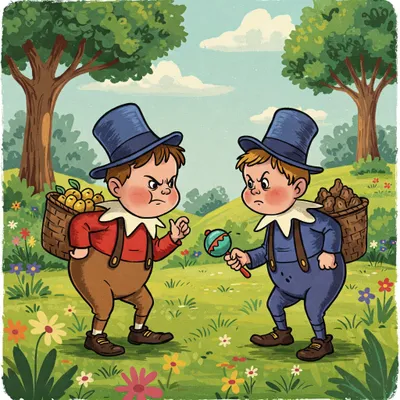
Tweedledum and TweedledeeAgreed to have a battle;For Tweedledum said TweedledeeHad spoiled his nice new rattle.
Just then flew down a monstrous crow,As black as a tar-barrel;Which frightened both the heroes so,They quite forgot their quarrel.
History and Meaning
Tweedledum and Tweedledee agree to fight over a broken rattle, then a giant crow scares them both off before a blow is struck. The names began as an insult: a 1725 poet coined them to mock two feuding composers whose differences he thought trivial, and the pair have meant "two of a kind" ever since.
Origins
The names first appeared in print in 1725 in a satirical epigram written by the poet John Byrom. Byrom's verse was a satirical critique of the bitter rivalry between the famous composers George Frideric Handel and Giovanni Bononcini, suggesting that their musical differences were trivial, like "tweedle-dee" and "tweedle-dum." The nursery rhyme itself, describing the battle over the rattle and the giant crow, was first published around 1805 in the collection Original Ditties for the Nursery.
Meaning & Interpretation
The narrative is a lighthearted parody of serious military conflict. Instead of fighting for honor or land, the two "heroes" agree to battle over a minor childhood possession, a new rattle that Tweedledee reportedly spoiled. The sudden arrival of a "monstrous crow" as black as a tar-barrel represents an external threat that quickly unites the two rivals in fear, causing them to forget their argument. In 1871, the author Lewis Carroll popularized the characters in his novel Through the Looking-Glass, where Alice encounters the rotund twin brothers who recite the nursery rhyme, cementing their image in popular culture as identical, bickering twins.
What is the origin of Tweedledum and Tweedledee?
The names were first printed in a 1725 satirical poem by John Byrom to mock the rivalry between composers Handel and Bononcini. The actual nursery rhyme about the battle over a rattle was first published in print in 1805 in Original Ditties for the Nursery.
What is the difference between Tweedledum and Tweedledee?
In common language, there is no real difference between the two choices. The names are used as an idiom to describe two people or choices that are practically identical and interchangeable, a meaning popularized by Lewis Carroll's twins in his 1871 book Through the Looking-Glass.
Music Video
If the player is unavailable, watch this video on YouTube.
Lyrics from nurseryrhymes.info