
Fiddle-I-Fee
Lyrics
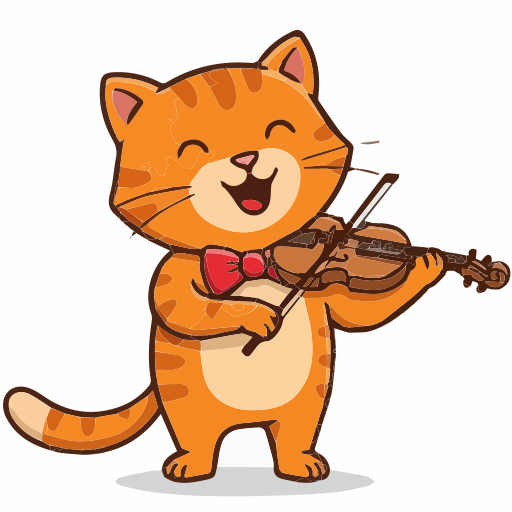
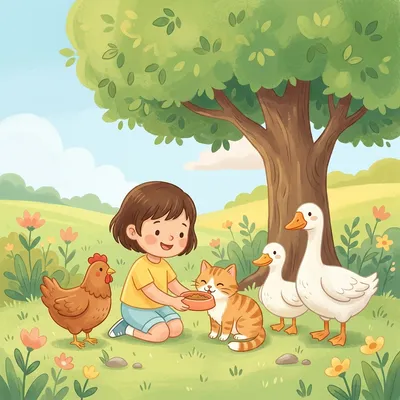
I had a cat and the cat pleased me,I fed my cat under yonder tree.Cat goes fiddle-i-fee.
I had a hen and the hen pleased me,I fed my hen under yonder tree.Hen goes chimmy-chuck, chimmy-chuck,Cat goes fiddle-i-fee.
I had a duck and the duck pleased me,I fed my duck under yonder tree.Duck goes quack, quack,Hen goes chimmy-chuck, chimmy-chuck,Cat goes fiddle-i-fee.
I had a goose and the goose pleased me,I fed my goose under yonder tree.Goose goes swishy-swashy,Duck goes quack, quack,Hen goes chimmy-chuck, chimmy-chuck,Cat goes fiddle-i-fee.
History and Meaning
"Fiddle-i-fee" is what the cat says. That is the whole of it. The cat does not meow in this song, it goes fiddle-i-fee, and every verse that follows has to climb back down the ladder of animals to say so again. Many people know the same song as "Bought Me a Cat", which is the title Aaron Copland used when he arranged it, and the two names cover the same traditional words.
The structure is the point. Verse one buys a cat and gives its sound. Verse two buys a hen, gives the hen's sound, then returns to the cat. Verse three adds a duck and runs duck, hen, cat. By the fifth or sixth animal the singer is reciting a long string of noises at speed, and the comedy comes from the accelerating recital rather than from any joke in the words.
Origins
This is a long-established traditional cumulative song, and its first printing is not firmly established. It belongs to a family of farmyard songs catalogued as Roud 544, known on both sides of the Atlantic, with the animals and their sounds swapping around from one version to the next. Collectors found it in circulation in England in the early twentieth century, including versions noted in Oxfordshire around 1916.
The best-documented American appearance comes from the same period. The singer Loraine Wyman and the composer Howard Brockway spent six weeks collecting in eastern Kentucky in 1916, and printed "The Barnyard Song" in their collection Lonesome Tunes that year. Their text opens with the cat that pleased the singer, fed under yonder tree, going fiddle-i-fee.
Aaron Copland set the song as "I Bought Me a Cat" in Old American Songs, Set I, in 1950. The premiere was given that June by the tenor Peter Pears with Benjamin Britten at the piano, and Copland later made choral versions in 1952 and 1959. The words he used are traditional and belong to nobody. The arrangement is his.
Meaning & Interpretation
There is nothing hidden here. The song is a memory game dressed as a farm inventory, and it works the way "The Twelve Days of Christmas" and "There Was an Old Lady Who Swallowed a Fly" work: a growing list that the singer has to hold in order.
What makes it more useful than most counting songs is that every item is a sound rather than a number. Children who cannot yet count to eight can still produce a moo, and the recital rewards them for tracking sequence instead of arithmetic. The animals also get progressively sillier in their assigned noises, since a goose going swishy-swashy is already a comic invention rather than a real imitation.
To run it with a group, assign one animal to each child or each small cluster of children. Sing the new verse together, then point down the line so each group calls out its own sound in turn. Speed up on every repeat. If you have fewer children than animals, give the whole room the cat, since the cat is the last sound in every single verse and is the one everybody will learn first.
What does "fiddle-i-fee" mean?
Nothing. It is a nonsense refrain syllable, invented for its sound, and it does not translate into any word or phrase. Folk songs are full of these filler phrases, and this one exists because it is fun to say quickly and it fits the tune. Anyone searching for a definition will not find one, because there is no meaning underneath it.
Is Fiddle-I-Fee the same song as Bought Me a Cat?
Yes. The two titles cover the same traditional cumulative song, and versions also circulate as "The Barnyard Song" and "The Farmyard Song". Song titles in folk tradition usually come from whichever line the collector or publisher chose to name it after, so "Fiddle-I-Fee" takes the refrain and "Bought Me a Cat" takes the opening. Copland's setting made the second title the better known one in concert programmes.
How many verses does Fiddle-I-Fee have?
As many as the singers can manage. The four printed above are the common opening run, and the song continues with animals such as the sheep, the pig, the cow and the horse, each one added at the top and each one pushing the recital longer. There is no fixed ending and no fixed animal list, so different families and different regions stop at different points.
Why is the cat always last?
Because the song builds by adding each new animal at the front of the list and working backwards to the start. The cat arrived first, so it stays at the bottom of the chain no matter how long the chain grows. That repetition is what fixes the refrain in a child's memory after only two or three verses.
Related Nursery Rhymes


Lyrics from nurseryrhymes.info