

Katie Bairdie

Lyrics
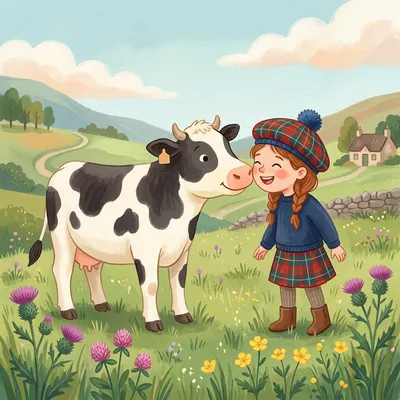
Katie Bairdie had a coo,Black and white about the mou,Wasna that a dainty coo?Dance, Katie Bairdie!
Katie Bairdie had a hen,It could whistle butt and ben,Wasna that a dainty hen?Dance, Katie Bairdie!
Katie Bairdie had a cat,It could eat baith moose and rat,Wasna that a dainty cat?Dance, Katie Bairdie!
Katie Bairdie had a grice,It could skate upon the ice,Wasna that a dainty grice?Dance, Katie Bairdie!
Katie Bairdie had a wean,That widnae play oot in the rain,Wasna that a dainty wean?Dance, Katie Bairdie!
History and Meaning
A lute manuscript compiled in Ayrshire somewhere between 1612 and 1628 contains a tune headed "Katherine Bairdie". That single line of ink is the reason this small Scots counting-off song gets called the oldest children's rhyme in Scotland. It is a good claim but not a settled one, because the manuscript preserves a tune title and no words at all. The verses that Scottish children sing today were not written down until roughly two centuries later.
The song is built for repetition. Katie owns an animal, the animal does something no animal should be able to do, the singer asks whether it was not a dainty one, and everybody shouts the name. Toddlers work out the pattern after two verses and start supplying their own.
Origins
The earliest firm trace is the Rowallan Manuscript, the lute book associated with Sir William Mure of Rowallan, usually dated 1612 to 1628. It lists "Katherine Bairdie" among its tunes. A version of the same air turns up in the Skene Manuscript, another early Scottish collection from the same broad period. Both are music books. Neither carries the rhyme.
For words, the trail starts in the nineteenth century. The Galloway collector John Mactaggart recorded a related song and dance called "Dolly Beardy" in 1824. Robert Chambers then printed "Katie Beardie" with its animal verses in the enlarged editions of his Popular Rhymes of Scotland in the 1840s, and it is essentially Chambers's text that schools and Bookbug sessions still use, with the spelling modernised toward "Bairdie".
Iona and Peter Opie, in The Oxford Dictionary of Nursery Rhymes, put it carefully: there is tolerable proof that the song is more than three centuries old. That is a claim about the tune and the name, which the manuscripts do support. Older dates circulate too, including a frequently repeated 1567 attestation. No printed 1567 source containing Katie Bairdie has ever been produced in the standard reference works, so treat that date as unproven and use the early 1600s manuscripts instead.
Who Katie Bairdie was is also unknown. Bairdie or Beardie means the bearded one, and in some early variants the name attaches to a man rather than a woman. Anything more specific is guesswork.
Meaning & Interpretation
There is no hidden history here, no plague and no beheaded queen. The joke is simply that each animal does the wrong job. A hen whistles through the house, a cat clears out mice and rats like a paid mouser, a young pig goes skating. "Dainty" is used in its older Scots sense of fine or excellent rather than delicate, so each line is a small brag about a ridiculous animal.
The last verse is the one that lands with parents. The wean who will not play out in the rain is called dainty along with the cow and the pig, and in a country where rain is the default weather, that is dry Scottish teasing aimed straight at the child on your knee.
Because the structure is a slot you fill, the verse list has never been fixed. Chambers printed some animals, Bookbug groups sing others, and classrooms in Scotland routinely add a crocodile or a dinosaur. Adding your own verse is not a corruption of the rhyme. It is how the rhyme has always worked.
What do the Scots words mean?
coo - cow mou - mouth about the mou - around the muzzle wasna - was not dainty - fine, excellent, worth showing off butt and ben - the outer and inner rooms of a small cottage, so "all through the house" baith - both moose - mouse grice - a young pig wean - a child (rhymes with "rain", short for "wee ane", little one) widnae - would not oot - out bairdie - the bearded one, used here as a name
Is Katie Bairdie really the oldest Scottish nursery rhyme?
It is one of the oldest with documentary backing, though the evidence covers the tune rather than the words. "Katherine Bairdie" appears as a tune title in the Rowallan lute manuscript of about 1612 to 1628 and in the Skene Manuscript, which makes the melody roughly four hundred years old. The verses about the cow and the hen are only recorded from the 1820s and 1840s onward, so nobody can prove that seventeenth century children sang these exact lines.
How do you sing Katie Bairdie?
It is a short, bouncy four-line tune, closely related to the melody used for "London Bridge Is Falling Down", so if you can sing that you can carry this. Each verse ends with "Dance, Katie Bairdie!", which is the cue to bounce the child, clap, or get everyone on their feet. Many groups sing a "diddle-dee-dee" chorus between verses to give the singers a breather and the children a chance to move.
Related Nursery Rhymes




Lyrics from nurseryrhymes.info