

How Doth the Little Crocodile


Lyrics
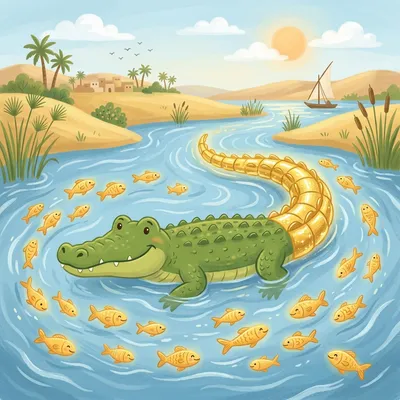
How doth the little crocodileImprove his shining tail,And pour the waters of the NileOn every golden scale!
How cheerfully he seems to grin,How neatly spreads his claws,And welcomes little fishes in,With gently smiling jaws!
History and Meaning
Alice tries to recite a poem she has learned by heart, and the wrong one comes out. That is the joke, and it only works if you know the poem she was aiming at. Victorian children did. Isaac Watts's "Against Idleness and Mischief", written in 1715, was a standard schoolroom memorisation piece, and it begins "How doth the little busy bee improve each shining hour".
Origins
Carroll published the parody in Alice's Adventures in Wonderland in 1865, in the second chapter, where Alice recites it and concludes that she must have turned into a different child overnight. Watts's original is a short moral poem holding up the honeybee as a model of hard work and warning that idle hands find mischief.
Carroll keeps Watts's metre and his opening words, then swaps the industrious bee for a crocodile. Several of the poems in the Alice books work this way, taking a piece of improving verse that readers had drummed into them and letting the sense slide.
Meaning & Interpretation
The humour is in what the crocodile is doing while sounding virtuous. He improves his tail, spreads his claws neatly, grins cheerfully, and welcomes little fishes in. Every one of those phrases would be a compliment in Watts's poem. Here they describe an animal grooming itself and eating.
The last two words do the work. "Gently smiling jaws" is a polite way of saying open mouth, and the fishes have been welcomed into it. Carroll never says what happens next, which is why the poem is funny rather than grim.
What poem is How Doth the Little Crocodile making fun of?
Isaac Watts's "Against Idleness and Mischief", published in 1715 in Divine Songs for Children. It praises the busy bee for working all day and warns children that Satan finds work for idle hands. It was widely taught, so Carroll's readers recognised the parody instantly.
What does "doth" mean?
"Doth" is an older form of "does". "How doth the little crocodile improve his shining tail" simply means "how does the little crocodile improve his shining tail". Watts's original used the same old-fashioned form, and Carroll kept it to make the imitation obvious.
Why does Alice recite this poem in Wonderland?
She is testing whether she is still herself after all the changes in size, and reciting a familiar poem is how she checks. The words come out wrong, which convinces her she has been swapped for another child. It is one of the first signs in the book that the rules she relies on no longer hold.
Related Nursery Rhymes






Lyrics from nurseryrhymes.info