
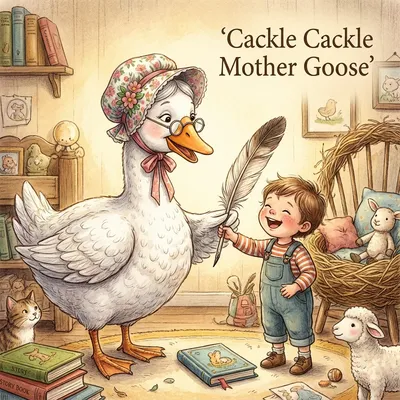
Cackle Cackle Mother Goose

Lyrics
Cackle, cackle, Mother Goose,Have you any feathers loose?Truly have I, pretty fellow,Half enough to fill a pillow.Here are quills, take one or two,And down to make a bed for you.
History and Meaning
This rhyme takes the Mother Goose of the storybooks, the imaginary old woman who supposedly authored the nursery rhymes, and turns her into a literal goose you can pluck for feathers. She offers up enough down to half-fill a pillow. The fun is the blur between the storyteller and the bird.
Where does the name Mother Goose come from?
The earliest known use of "Mother Goose" as a storytelling figure appears in French literature. Charles Perrault published his famous fairy tale collection "Contes de ma Mere l'Oye" (Tales of My Mother Goose) in 1697, which included stories like Cinderella, Sleeping Beauty, and Little Red Riding Hood. The name may derive from an even older oral tradition, as references to a goose-footed queen appear in medieval French and German folklore.
In England, the name became associated with nursery rhymes rather than fairy tales. John Newbery, the pioneering children's publisher, released "Mother Goose's Melody" around 1765, a collection of traditional English nursery rhymes attributed to the fictional Mother Goose. This established the connection between Mother Goose and nursery rhymes that persists to this day, particularly in the English-speaking world.
What is the rhyme about?
"Cackle, Cackle, Mother Goose" is a short, lighthearted verse that imagines Mother Goose as an actual goose laying eggs. The rhyme asks whether she has any feathers to sell, and she promises a bed-full. The humour comes from the playful blurring of the line between Mother Goose as a storytelling figure and Mother Goose as a literal farmyard bird.
Why does Mother Goose matter?
The concept of Mother Goose as the source of nursery rhymes has been enormously influential. It gave children's verse an identity, a kindly, grandmotherly figure who told stories and sang songs. Countless nursery rhyme anthologies have been published under the Mother Goose name over the past three centuries, and the figure remains one of the most recognisable symbols of children's literature in the English-speaking world.
In America especially, "Mother Goose" is virtually synonymous with nursery rhymes themselves. The Boston Mother Goose, published in the early 19th century, helped cement this association and ensured that generations of American children grew up thinking of their favourite rhymes as coming from the lips of a wise and whimsical old goose.
Lyrics from nurseryrhymes.info