
Engine, Engine, Number Nine

Lyrics
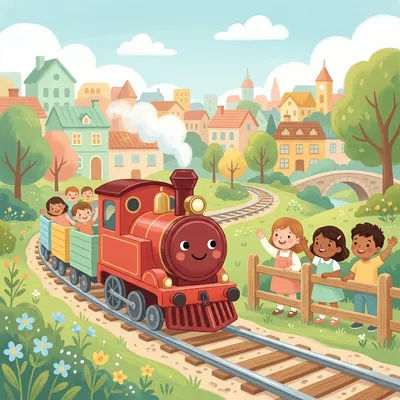
Engine, engine, number nine,Going down Chicago line.If the train should jump the track,Do you want your money back?
Yes, no, maybe so.Y-E-S spells yes,And you are not it.
History and Meaning
This is a tool, not a song. Children use "Engine, Engine, Number Nine" to settle an argument before a game starts, deciding who has to be the chaser, the seeker, or the one left out. One child points around the circle while chanting, and the pointing does the choosing. Nobody has to be talked into it, and no adult has to referee. The train imagery is a pleasant surface on a piece of playground machinery that has one job.
Origins
The rhyme is American and circulated by word of mouth among schoolchildren, which means there is no first author and no first printing to point at. Folklorists generally place it in the early twentieth century, when steam locomotives were the most exciting machines a child was likely to see. Railroad rhymes multiplied in the same period, and this one kept its footing because the rhythm is so easy: four heavy beats to a line, exactly what a pointing finger needs.
Counting-out rhymes as a class were collected seriously well before that. Henry Carrington Bolton published a study of them in 1888 that gathered hundreds of examples and traced how the same nonsense travelled between countries. Later, Iona and Peter Opie did similar fieldwork in British schoolyards. Their work established the pattern this rhyme belongs to, even where a specific text cannot be dated.
Wording drifts by region and always has. "Going down Chicago line" is the most widespread American second line, but children substitute their own city or railway freely, and versions collected elsewhere in the English-speaking world swap in a local route. "If the train should jump the track" also appears as "goes off the track". None of these is more correct than another; oral rhymes have no authorised edition.
Meaning & Interpretation
The little scene is a joke about a derailment, delivered deadpan. The train comes off the rails and the only question anyone asks is about a refund. Children are not thinking about the crash. They are enjoying the mock seriousness of a ticket dispute, the same way they enjoy playing shop or telling someone off in a grown-up voice.
The Chicago reference is doing scene-setting rather than history. Chicago was the great American rail hub, so "Chicago line" reads as shorthand for a big serious railway. There is no documented link between this rhyme and any particular company or route, and claims that it commemorates a specific wreck should be treated with suspicion unless a source is produced.
Away from the playground, the rhyme works well as a toddler action chant. Sit the child on your knee and bounce on the four beats of each line, then rock sideways on "jump the track" and pause for the question. Two-year-olds who cannot yet count will still feel the pulse, which is the part that later makes the counting game work.
What is a counting-out rhyme?
A counting-out rhyme is how children choose who is "it" without an adult deciding for them. Everyone stands in a circle, one child recites the rhyme, and on each stressed syllable that child points to the next person in turn. Whoever the final word lands on is either picked or eliminated, depending on the game. Because the outcome falls out of the rhythm rather than anyone's preference, the result feels fair and arguments stop. "Eeny, meeny, miny, moe" and "One potato, two potato" do the same job.
How do you play Engine, Engine, Number Nine?
Stand in a circle with fists or feet in the middle. One child chants the four lines, tapping a different fist or foot on each strong beat. In the simplest version, whoever is tapped on the last word is out, and you chant again until one player remains and becomes "it". In the extended version, the child who is tapped on "money back" answers yes or no. The caller then spells that answer out, one letter per tap, and finishes with a line such as "Y-E-S spells yes and you are not it". The spelling adds letters to the count, so the answer chosen changes who the rhyme lands on.
Why do children spell out the answer at the end?
Spelling the answer makes the game less predictable. Older children work out that a fixed rhyme always lands on the same position in a circle of a known size, and they simply stand somewhere safe. Letting a player choose yes or no inserts two or three extra beats that nobody can plan around, so the result stops being calculable. It also gives the tapped child a small say in the outcome, which keeps them interested.
Is Chicago line a real railroad?
Not a specific one. Chicago was the busiest rail junction in the United States, with many companies running lines into it, so "Chicago line" functions as a generic phrase for a mainline railway rather than a name. No documented connection ties this rhyme to a named railroad, and children in other places routinely replace Chicago with a city of their own.
Related Nursery Rhymes



Lyrics from nurseryrhymes.info