
If I Had a Donkey

Lyrics
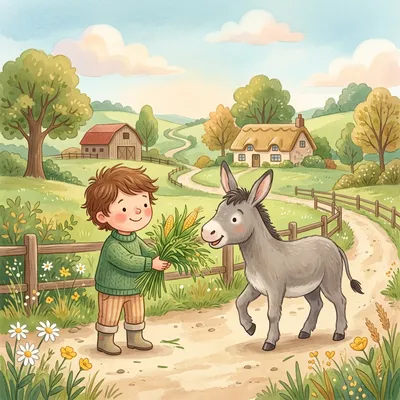
If I had a donkey that wouldn't go,Would I beat him? Oh no, no.I'd put him in the stable and keep him warm,The best little donkey that ever was born.
If I had a donkey that wouldn't go,D'ye think I'd wallop him? No, no, no.But gentle means I'd try, d'ye see,Because I hate all cruelty.
History and Meaning
On 22 July 1822 Parliament passed the Cruel Treatment of Cattle Act, which made it an offence to beat or ill-treat a working animal. Within months London street singers were selling a comic song built around the question the new law had just put to every carter and costermonger in the city: if your donkey will not move, what exactly are you allowed to do about it? The song's answer is nothing violent. Its chorus, shortened and smoothed out over the following century, is the nursery rhyme children still sing.
Almost no nursery rhyme can be traced to a specific piece of legislation. This one can, because the original version named the statute in its own lyrics.
Origins
The street-song version was titled "If I Had a Donkey Wot Wouldn't Go", printed on cheap broadsides with the deliberate misspellings that marked it as costermonger speech. It tells a small story about two donkey owners, one kind and one not, and its final couplet points straight at Westminster: "If all had been like me in fact, / There'd ha' been no occasion for Martin's Act." Dating it exactly is not possible, but it must postdate July 1822, since it refers to the Act as law.
That Act is usually called Martin's Act after Richard Martin, MP for Galway, who steered it through the Commons. It covered horses, mares, geldings, mules, asses, cows, heifers, steers, oxen and sheep, and set fines of between ten shillings and five pounds, with up to three months in prison for anyone who could not pay. Dogs, cats and bulls were left out. Martin was known as Humanity Dick, a nickname given to him by George IV, and he did not stop at passing the law; he brought prosecutions under it himself.
A widely reproduced print from around 1840 shows Martin in court prosecuting a costermonger named Bill Burns, with the beaten donkey led in as evidence. Legal historians have picked the story apart and found no defendant of that name in the records, so the print is best read as a piece of campaign publicity rather than a report.
Two years after the Act, on 16 June 1824, a group of twenty-two people met at Old Slaughter's Coffee House in St Martin's Lane to found the Society for the Prevention of Cruelty to Animals. Martin was in the room, as was William Wilberforce. Queen Victoria granted the society royal status in 1840, making it the RSPCA.
Meaning & Interpretation
The rhyme is a refusal, and the refusal is the whole point. The speaker sets up the one situation where a nineteenth-century driver would have reached for a stick, then declines. In the nursery version he goes further and rewards the animal instead, stabling it and keeping it warm.
For a song written to sell on the street, that is a shrewd piece of persuasion. It does not lecture. It hands the listener a stubborn donkey and lets them agree, in chorus, that they would not hit it either. Sung to a child today it works as a simple lesson about looking after an animal that is having a difficult day, which is more or less what its author intended, minus the legislation.
What was Martin's Act?
Martin's Act is the common name for the Cruel Treatment of Cattle Act 1822, which received royal assent on 22 July 1822 and is generally regarded as the first animal welfare law passed by a Western parliament. It made wantonly beating, abusing or ill-treating listed working animals a criminal offence punishable by a fine of ten shillings to five pounds, or up to three months in prison. It was named for Richard Martin, the MP who piloted it through the House of Commons.
Who was Humanity Dick?
Humanity Dick was Colonel Richard Martin (1754 to 1834), an Irish landowner and MP for Galway who campaigned against cruelty to animals. King George IV gave him the nickname. Besides securing the 1822 Act, Martin personally brought cases under it and was among the founders of the Society for the Prevention of Cruelty to Animals in 1824.
Is If I Had a Donkey a nursery rhyme or a street song?
It began as a street and music-hall song for adults and became a nursery rhyme afterwards. The early broadside version is longer, written in mock costermonger dialect, and ends by naming Martin's Act. The four-line verse sung to children keeps the chorus idea, drops the dialect and the legal reference, and adds the stable and the warmth.
What does "wot wouldn't go" mean?
It means "that would not move", written the way the song's narrator was imagined to speak. "Wot" is a printed rendering of a London working-class pronunciation of "what", used on the broadsides to signal that the singer was a street trader rather than a gentleman.
Related Nursery Rhymes

Lyrics from nurseryrhymes.info