
If All the World Were Paper

Lyrics
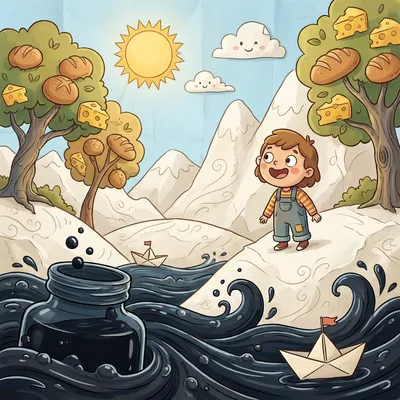
If all the world were paper,And all the sea were ink,If all the trees were bread and cheese,What should we have to drink?
History and Meaning
"If All the World Were Paper" swaps the real world for an absurd one, paper land, an ink sea, trees of bread and cheese, then asks the only sensible question: what would we have to drink? It first turned up in print in the 1640s among collections of jokes and riddles.
When was it first published?
The earliest known printed version appears in a 1641 collection of wit and humour. The rhyme was included among various jests, riddles, and comic verses popular in 17th-century England. However, its oral origins may be older still. The tradition of "what if" nonsense questions was well established in medieval European folklore, where scholars and entertainers would pose ridiculous hypothetical scenarios for amusement.
What does the rhyme mean?
The rhyme poses a series of impossible questions: what if the world were paper, what if the sea were ink, what if trees were bread and cheese, and what would we have to drink? Each line replaces something real with something absurd, creating a cascade of delightful impossibilities.
There is no hidden meaning or allegory. The rhyme is pure nonsense, designed to make children laugh and to stretch their imaginations. Its appeal lies in the joyful absurdity of picturing familiar things transformed into something completely different.
Why is nonsense verse important for children?
Nonsense rhymes like this one play a valuable role in early language development. By presenting impossible scenarios in a structured, rhyming format, they help children understand the difference between real and imaginary. They also build vocabulary, since children encounter unusual word combinations they would never hear in everyday speech.
The "what if" structure encourages creative thinking and helps children practise the kind of hypothetical reasoning that becomes important in later education. When a child hears "if all the world were paper," they must hold an impossible idea in their mind and follow its logical consequences, a surprisingly sophisticated cognitive exercise wrapped in silly fun.
The rhyme in popular culture
The verse has appeared in numerous nursery rhyme collections over the centuries, from the chapbooks of the 18th century to modern illustrated anthologies. Its enduring popularity shows how durable good nonsense can be. Nearly four hundred years after it was first written down, the image of a world made of paper still delights children.
Lyrics from nurseryrhymes.info