

Daffy Down Dilly
 England
 Lyrics
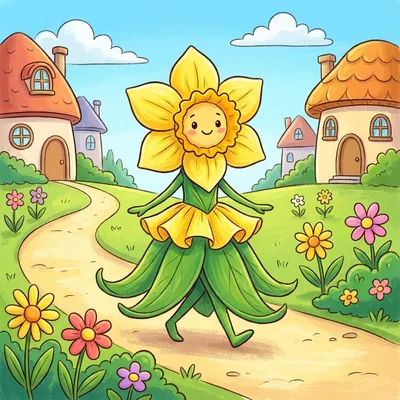
In a yellow petticoat and a green gown.
History and Meaning
This short rhyme personifies the daffodil flower, describing its yellow petals and green stem as clothing, with the term "daffy-down-dilly" itself having been used as a popular name for the daffodil flower since the 1500s according to the Oxford English Dictionary. The "Daffy Down Dilly" nursery rhyme as it is commonly recognized is believed to have originated in the 19th century, with its first notable literary mention appearing in American author Nathaniel Hawthorne's 1843 novel titled "Little Daffy-down-dilly," where Hawthorne used "Daffy-down-dilly" to personify a character with a beautiful and agreeable personality, likening her to a daffodil. The rhyme typically describes "Daffy-down-dilly" arriving in town wearing a yellow petticoat and a green gown, drawing a direct comparison between the maiden's attire and the colors of the daffodil flower, and due to Hawthorne's American origins, it is speculated that the song may have originated in the United States. The personification of daffodils has ancient roots in the Greek myth of Narcissus, who fell in love with his own reflection, connecting the flower to human-like attributes and emotions, and later literary personification appears in William Wordsworth's famous 1804 poem "I Wandered Lonely as a Cloud," where he describes the flowers as "dancing" and "tossing their heads in sprightly dance."