
Dance, Thumbkin, Dance

Lyrics
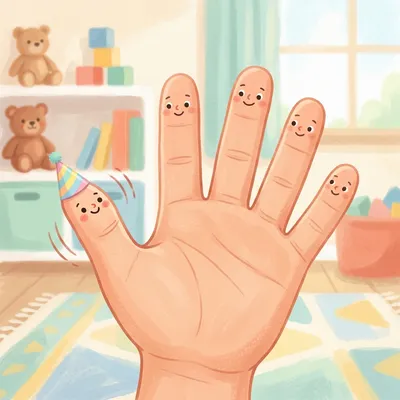
Hold up one hand with the fingers spread. In each verse, wiggle only the finger being named and keep the rest still.
Dance, Thumbkin, dance,Dance, ye merrymen, every one.But Thumbkin, he can dance alone,Thumbkin, he can dance alone.
Now the first finger.
Dance, Foreman, dance,Dance, ye merrymen, every one.But Foreman, he can dance alone,Foreman, he can dance alone.
Now the middle finger.
Dance, Longman, dance,Dance, ye merrymen, every one.But Longman, he can dance alone,Longman, he can dance alone.
Now try the ring finger. It will not go by itself, and that is the joke.
Dance, Ringman, dance,Dance, ye merrymen, every one.But Ringman, he cannot dance alone,Ringman, he cannot dance alone.
Now the little finger.
Dance, Littleman, dance,Dance, ye merrymen, every one.But Littleman, he can dance alone,Littleman, he can dance alone.
Finish by wiggling the whole hand.
History and Meaning
The whole rhyme is built around a trick that nobody in the nursery can beat. Four fingers get a verse each saying they can dance alone, and one, Ringman, gets a verse saying he cannot. Hand a child this song and they will spend the next five minutes glaring at their own ring finger, willing it to move while the others stay flat. It never quite works, which is exactly why the rhyme has stayed in circulation.
The other reason to know it is the vocabulary. Thumbkin, Foreman, Longman, Ringman and Littleman are the old English household names for the five digits, and the song is one of the last places those names survive in daily use.
Origins
The rhyme belongs to the family of English finger-plays collected and printed through the nineteenth century, when antiquarians such as James Orchard Halliwell began writing down the game-rhymes that had until then only been said aloud. It appears in later Victorian anthologies as well, including Andrew Lang's The Nursery Rhyme Book of 1897, illustrated by L. Leslie Brooke.
Collectors recorded several variants of the middle verses. The middle finger turns up as Longman, Longman's brother Middleman, or simply Middleone depending on the county. The ring finger is usually Ringman, but a few versions preserve the older Lecheman or Leche-man. Halliwell noted the explanation given in his day: a leche was a physician, and the finger was said to be the one a doctor used for tasting, or else the finger whose beat was believed to run straight to the heart. That second idea is the same folk belief that put wedding rings on that finger in the first place. It is folklore rather than anatomy, but it is old folklore.
"Merrymen" is not a nonsense word either. It is the standard term for a band of followers, the sense familiar from Robin Hood and his merry men. The singer is addressing the hand as a little company and calling them all up to dance together before singling one out.
The rhyme sits alongside Tommy Thumb Is Up and Where Is Thumbkin in the same tradition of songs that name the fingers one by one. Thumbkin is the shared character across all three, and the pattern of working from thumb to little finger is common to the group.
Meaning & Interpretation
There is no hidden history here, no plague or politics. The song is a physical test dressed up as a verse, and it does two useful things at once. It teaches the names and order of the fingers, and it gives a small child a genuinely hard motor task with a built-in punchline for failing it.
The failure is the point. Most players discover during the Ringman verse that they cannot do what the other four verses asked, and the rhyme has already told them not to worry about it. That is an unusually generous piece of design for a nursery game, which more often ends in a tickle or a fall.
Older children start hunting for workarounds, pressing the other fingers down on a table so the ring finger has to move by itself. That is a fair adaptation and it does make the movement easier, though the finger still lags behind the rest.
What are the old finger names in Dance, Thumbkin, Dance?
Each name matches one digit. Thumbkin is the thumb. Foreman, sometimes called Pointer, is the index or first finger, so named because it is the foremost of the four. Longman is the middle finger, the longest. Ringman is the ring finger, the one that wears a wedding ring, and older versions call it Lecheman after the physician's finger. Littleman is the little finger or pinkie.
Why can't the ring finger dance alone?
The ring finger genuinely is the least independent of the four, and the reason is in the hand's plumbing. The tendons that straighten the middle, ring and little fingers are tied together on the back of the hand by fibrous bands called juncturae tendinum, so pulling on one drags a little on its neighbours. The index and little fingers also each have an extra extensor muscle of their own, the extensor indicis and the extensor digiti minimi, which the ring finger does not have. Studies that measure finger independence consistently rank the ring finger last. It is not immobile, and practice improves it, but it will always bring its neighbours partway along.
How do you play Dance, Thumbkin, Dance?
Hold one hand up in front of the child, palm out, fingers spread. Wiggle only the named finger through each verse while the rest stay as still as you can manage, then swap and let the child try the same hand. Slow the song down for the Ringman verse so the difficulty registers, and finish by shaking the whole hand loose. Two hands at once turns it into a much harder version for older children.
Related Nursery Rhymes


Lyrics from nurseryrhymes.info