

Dame, Get Up and Bake Your Pies


Lyrics
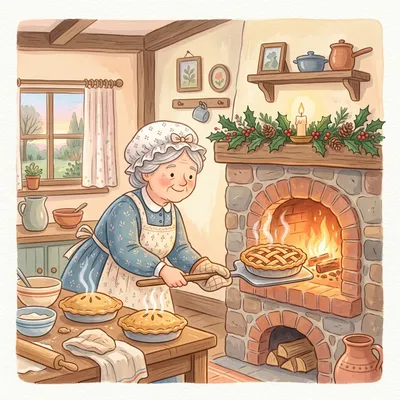
Dame, get up and bake your pies,Bake your pies, bake your pies;Dame, get up and bake your pies,On Christmas day in the morning.
Dame, what makes your maidens lie,Maidens lie, maidens lie;Dame, what makes your maidens lie,On Christmas day in the morning?
Dame, what makes your ducks to die,Ducks to die, ducks to die;Dame, what makes your ducks to die,On Christmas day in the morning?
Their wings are cut and they cannot fly,They cannot fly, they cannot fly;Their wings are cut and they cannot fly,On Christmas day in the morning.
History and Meaning
The earliest known printing of this rhyme is not a carol book. It is a collection of County Durham legends and songs published in 1834, and the verses sit there as a piece of local Christmas noise rather than as church music. That fits what the words are doing. Somebody is standing over a still-sleeping household on Christmas morning, shouting at the mistress of the house to get up, because the pies are not going to bake themselves.
Then the shouting turns into questions, and the questions turn silly. Why are the maids still in bed? Why are the ducks dying? The last verse answers with a shrug about clipped wings, and the whole thing has spun from a genuine order into a joke in four short stanzas. The repeated line "on Christmas day in the morning" carries all of it along, the same refrain shape used in the carol "I Saw Three Ships".
Origins
Sir Cuthbert Sharp printed the verses in The Bishoprick Garland (1834), his gathering of legends, songs and ballads belonging to the County of Durham. In that version the opening line runs "Maids, get up and bake your pies" and the refrain ends "'Tis Christmas day in the morning". Eight years later James Orchard Halliwell included it in The Nursery Rhymes of England (1842) in the form most people know now, with "Dame" at the head of the first line. It is catalogued as Roud 497.
The rhyme is sometimes given an eighteenth-century date, often something around 1780. That date belongs to the melody the words are usually sung to, not to the words themselves. No printing of this text earlier than the 1830s has been traced, and the confusion between the age of a tune and the age of a set of lyrics is one of the most common mistakes made about old rhymes. The words are best described as early nineteenth century in print, with an unknown period of singing behind them in the north of England.
Meaning & Interpretation
Christmas pies were serious work. Through the seventeenth and eighteenth centuries a Christmas pie in England meant a mince pie in its older sense, minced beef or tongue with suet, apples, currants, raisins and spice, made in quantity and made to last. Meat only dropped out of the recipe in the late Victorian period. Baking on that scale started before daylight, which is exactly why the rhyme opens with someone banging on a bedroom door. The instruction is not affectionate. It is a household under pressure with a feast to get out.
The second and third verses read as teasing rather than complaint. The maids lying abed on the one morning of heaviest work is a standing joke, and the ducks are dying because they are being killed for the table. The final answer, that their wings are clipped so they cannot escape, is deadpan nonsense of the kind children repeat happily without examining. Some singers treat the last verse as the ducks' own excuse for not getting away.
This belongs to the tradition of Christmas household bustle rather than to religious carolling. Its neighbours are rhymes about food, money and preparation, such as Christmas Is Coming with its goose getting fat, rather than anything sung in a church. Sing it fast and loud, since it was written to wake people up.
What are the pies in this rhyme?
They are Christmas pies, which in England at the time meant mince pies of the older savoury kind: minced beef or tongue mixed with suet, dried fruit and spices, baked in batches for the holiday. They were a substantial part of Christmas provisioning rather than a small sweet treat, and preparing enough of them for a household took most of a working day.
Is Dame, Get Up and Bake Your Pies a carol?
Not in the religious sense. It has no nativity content and no devotional language, and its first appearance was in a book of regional songs and legends from County Durham rather than a hymn collection. It is a seasonal work song and nursery rhyme about the domestic rush of Christmas morning, and it shares its refrain pattern with carols without being one.
What does "their wings are cut and they cannot fly" mean?
Clipping a bird's wing feathers stops it flying away, a normal practice for keeping poultry. In the rhyme it is offered as the reason the ducks are dying on Christmas morning, meaning they could not escape being caught for the Christmas table. The logic is deliberately absurd, which is the joke the last verse is built on.
Related Nursery Rhymes

Lyrics from nurseryrhymes.info