

Five Currant Buns

Lyrics
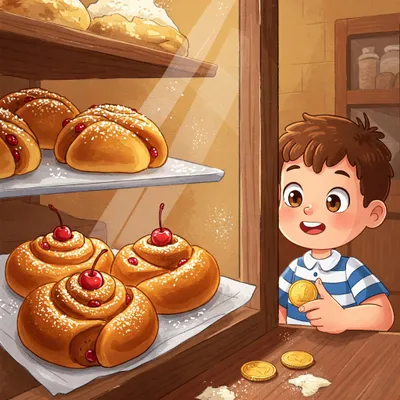
Five currant buns in a baker's shop.Big and round with a cherry on the top,Along came a boy with a penny one day,Bought a currant bun and took it away.
Four currant buns in a baker's shop.Big and round with a cherry on the top,Along came a boy with a penny one day,Bought a currant bun and took it away.
Three currant buns in a baker's shop.Big and round with a cherry on the top,Along came a boy with a penny one day,Bought a currant bun and took it away.
Two currant buns in a baker's shop.Big and round with a cherry on the top,Along came a boy with a penny one day,Bought a currant bun and took it away.
One currant bun in a baker's shop.Big and round with a cherry on the top,Along came a boy with a penny one day,Bought the currant bun and took it away.
History and Meaning
"Five Currant Buns" is a traditional English counting nursery rhyme and singing game popular in early childhood education. The song uses a simple, repetitive structure to introduce children to numbers, subtraction, and basic transactions.
Origins
The precise origins of "Five Currant Buns" remain undocumented. The song is a traditional piece of folklore that grew out of oral folk music traditions, likely taking its modern form in the early twentieth century. Because the rhyme was passed down through generations without a single author, there is no verified date or creator associated with its publication. It has long been a staple of nurseries and playgroups in English-speaking countries.
Meaning & Interpretation
The narrative is straightforward, describing five large, round currant buns topped with cherries sitting in a baker's shop. In each verse, a customer arrives with a penny, purchases a bun, and leaves, reducing the number of buns remaining. Teachers often adapt the lyrics, replacing the word "boy" with the names of children in the class to encourage active participation.
The song serves as an educational tool. By counting down from five to zero, children learn the concept of subtraction in a concrete, visual way. The rhyme also introduces the basic idea of commerce and exchange, showing that a penny is traded for a physical item. The physical play often associated with the rhyme, where children pretend to hold buns or hand over coins, helps develop motor skills.
What does the Five Currant Buns rhyme teach?
The rhyme teaches children how to count down from five to zero, illustrating the concept of subtraction. It also introduces young learners to the concept of buying goods with money.
How is the Five Currant Buns game played?
Children act as the currant buns while one child plays the baker. Other children walk up to the bakery with toy coins to buy a bun, taking one child away at the end of each verse.
Music Video
If the player is unavailable, watch this video on YouTube.
Related Nursery Rhymes


Lyrics from nurseryrhymes.info