
Aloo Kachaloo


Hindi Nursery Rhyme
Original Lyrics
Hindi script
आलू कचालू बेटा, कहाँ गए थे?बैंगन की टोकरी में सो रहे थे।बैंगन ने लात मारी, रो रहे थे।मम्मी ने प्यार किया, हँस रहे थे।
Romanized (pronunciation)
Aloo kachaloo beta, kahan gaye the?Baingan ki tokri mein so rahe the.Baingan ne laat maari, ro rahe the.Mummy ne pyaar kiya, hans rahe the.
English Translation
Potato, little Kachaloo, my boy, where did you go?I was sleeping in the basket of eggplants.The eggplant kicked me, I was crying.Mummy gave me a cuddle, I was laughing.
Translation Notes
Vocabulary
आलू (aloo) - potato कचालू (kachaloo) - a taro or yam-like tuber बेटा (beta) - son, child (used affectionately) कहाँ (kahan) - where बैंगन (baingan) - eggplant, aubergine टोकरी (tokri) - basket लात (laat) - a kick प्यार (pyaar) - love, affection
Grammar Notes
Past continuous with "rahe the": so rahe the (was sleeping), ro rahe the (was crying), and hans rahe the (was laughing) all pair a verb with rahe the to describe an action in progress in the past, much like English "was -ing." The the ending is masculine plural, the polite way the boy talks about himself.
The "ne" construction: in baingan ne laat maari (the eggplant kicked) and mummy ne pyaar kiya (Mummy loved), the doer takes the marker ne. Hindi tags the subject this way for completed past actions of many verbs, a pattern that often trips up learners.
Postposition "ki": baingan ki tokri means "basket of eggplants." The linking word ki comes after the noun and shifts between ka, ki, and ke to match what is owned, here the feminine tokri (basket).
Line-by-Line Translation
आलू कचालू बेटा, कहाँ गए थे? (Aloo kachaloo beta, kahan gaye the?) - "Potato, little Kachaloo, my boy, where did you go?"
- बेटा (beta) = son, dear child
- कहाँ (kahan) = where
- गए थे (gaye the) = had gone (past tense)
बैंगन की टोकरी में सो रहे थे (Baingan ki tokri mein so rahe the) - "I was sleeping in the basket of eggplants"
- बैंगन (baingan) = eggplant
- टोकरी में (tokri mein) = in the basket
- सो रहे थे (so rahe the) = was sleeping
बैंगन ने लात मारी, रो रहे थे (Baingan ne laat maari, ro rahe the) - "The eggplant kicked me, I was crying"
- लात मारी (laat maari) = gave a kick
- रो रहे थे (ro rahe the) = was crying
मम्मी ने प्यार किया, हँस रहे थे (Mummy ne pyaar kiya, hans rahe the) - "Mummy gave me a cuddle, I was laughing"
- प्यार किया (pyaar kiya) = showed love, cuddled
- हँस रहे थे (hans rahe the) = was laughing
History and Meaning
"Aloo Kachaloo" is a call-and-answer rhyme in which a mother scolds a small boy nicknamed after two vegetables, and he answers with a tall story: he was napping in the eggplant basket, an eggplant kicked him, he cried, and one hug from Mummy fixed everything. Indian preschoolers act it out with claps and gestures, and it is one of the first rhymes many of them learn.
The name itself is the joke. Aloo is potato and kachaloo is a knobbly tuber, so calling a child "Aloo Kachaloo" is roughly like calling him "little spud."
Origins
Like most Hindi balgeet (children's songs), "Aloo Kachaloo" has no recorded author or date. It comes from the oral playground tradition of North India and has been printed in countless preschool rhyme books and activity kits, usually with a clapping game attached.
Because it lives in oral tradition, the wording drifts from region to region. A widespread variant swaps the eggplant basket for a monkey's hut ("bandar ki jhopdi mein so rahe the"), and the last line sometimes has Mummy kiss the child rather than cuddle him. The version here is the one most commonly printed in Indian schoolbooks.
Meaning & Interpretation
The rhyme is built on a child's flair for a good excuse. Asked where he wandered off to, the boy invents a whole adventure among the vegetables. The comedy comes from the mismatch between the tiny crisis (an eggplant kicked me) and the tidy resolution (a hug), which lands with any toddler who has ever cried and then instantly forgotten why.
How do children play Aloo Kachaloo?
It is usually a partner clapping game. One child plays the mother and asks the question, the other plays "Aloo Kachaloo" and answers, and both clap out the rhythm. Some groups add actions for each line: sleeping, kicking, crying, and hugging.
What does Kachaloo mean?
Kachaloo (also spelled kachalu) is a common name for a starchy tuber, often taro or a small yam, sold by street vendors as a spiced snack. Paired with aloo (potato), it works as an affectionate, slightly teasing nickname rather than a literal description.
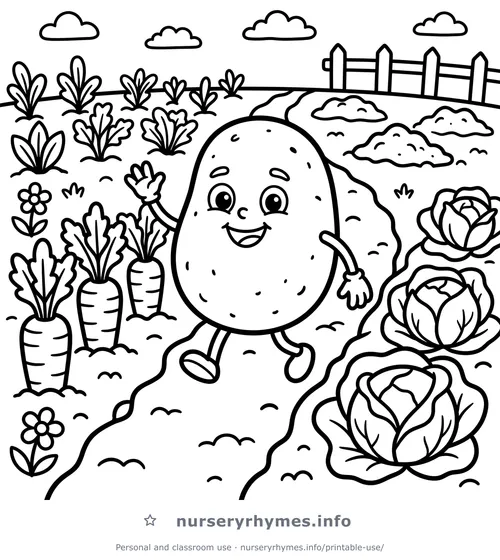
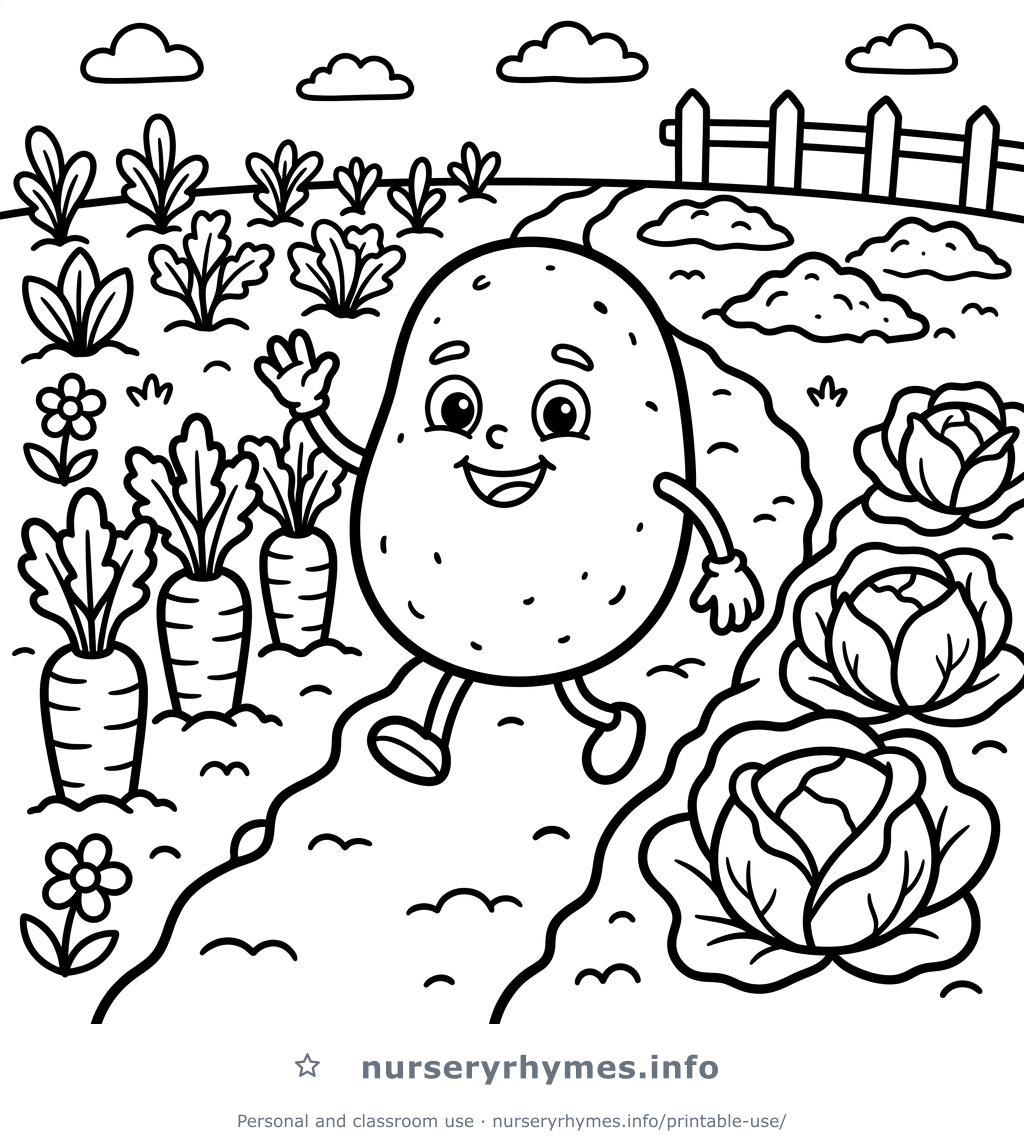
Free Printable Coloring Page
Print this Aloo Kachaloo coloring sheet for free and let little ones bring it to life with crayons or pencils.
Full-resolution PNG · Fits the paper size selected in your print dialog · Personal and classroom use
Lyrics from nurseryrhymes.info