

Akkad Bakkad Bambe Bo


Hindi Nursery Rhyme
Original Lyrics
Hindi script
अक्कड़ बक्कड़ बम्बे बो,अस्सी नब्बे पूरे सौ।सौ में लगा धागा,चोर निकल कर भागा।
Romanized (pronunciation)
Akkad bakkad bambe bo,Assi nabbe poore sau.Sau mein laga dhaaga,Chor nikal kar bhaaga.
English Translation
Akkad bakkad bambe bo,Eighty, ninety, a full hundred.At a hundred a thread was tied,The thief slipped out and ran.
Translation Notes
Vocabulary
अस्सी (assi) - eighty नब्बे (nabbe) - ninety पूरे (poore) - full, complete सौ (sau) - hundred धागा (dhaaga) - thread चोर (chor) - thief निकल (nikal) - come out, get out भागा (bhaaga) - ran, fled
Grammar Notes
Counting words: assi (80), nabbe (90), and sau (100) are everyday Hindi numbers. The rhyme is a painless way to fix the tens near a hundred in a child's memory.
"Poore" for emphasis: poore sau means "a full hundred," where poore stresses that the count reaches the whole, round number.
Conjunctive participle "nikal kar": nikal kar bhaaga means "having got out, ran," or more naturally "slipped out and ran." Adding -kar to a verb stem links one action to the next, a very common Hindi construction.
Line-by-Line Translation
अक्कड़ बक्कड़ बम्बे बो (Akkad bakkad bambe bo) - nonsense syllables chanted for rhythm, with no literal meaning
अस्सी नब्बे पूरे सौ (Assi nabbe poore sau) - "Eighty, ninety, a full hundred"
- अस्सी (assi) = eighty
- नब्बे (nabbe) = ninety
- पूरे सौ (poore sau) = a full hundred
सौ में लगा धागा (Sau mein laga dhaaga) - "At a hundred a thread was tied"
- सौ में (sau mein) = at a hundred
- धागा (dhaaga) = thread
चोर निकल कर भागा (Chor nikal kar bhaaga) - "The thief slipped out and ran"
- चोर (chor) = thief
- निकल कर (nikal kar) = having got out
- भागा (bhaaga) = ran away
History and Meaning
"Akkad Bakkad Bambe Bo" is the rhyme North Indian children chant to decide who is "it." One child points around the circle on each beat, and whoever the last word lands on is chosen, exactly the job that "Eeny, meeny, miny, moe" does in English. The opening line is pure nonsense sound, and then the count races from eighty to a hundred before a thief bolts off at the end.
Origins
The rhyme is a traditional counting-out chant with no known author, passed down orally across generations in India and neighbouring regions. Its power comes from rhythm rather than meaning: the first line, akkad bakkad bambe bo, is a string of nonsense syllables chosen for their beat, the same way English counting rhymes lean on sound over sense. Wordings vary from place to place, and children happily add their own extra lines.
Meaning & Interpretation
Only the second half of the rhyme carries any literal sense. The counting run, "eighty, ninety, a full hundred," gives the chant its momentum, and the closing image of a thread tied at a hundred and a thief running away supplies a tiny burst of story. None of it needs to be logical. What matters is that every syllable is a steady beat, so the pointing finger lands fairly on one player.
What does Akkad Bakkad Bambe Bo mean?
The first line has no dictionary meaning. Like "eeny, meeny, miny, moe," the words akkad bakkad bambe bo are rhythmic nonsense. The rest counts to a hundred and sketches a thief slipping away, but the rhyme's real purpose is selection, not storytelling.
How do children use the rhyme?
Players stand in a circle or hold out their fists. A leader taps one person (or one fist) on each syllable while chanting. The player marked by the final word is either chosen or eliminated, and the count runs again until only one is left. It settles who bats first, who chases in tag, or who is out.
Free Printable Coloring Page
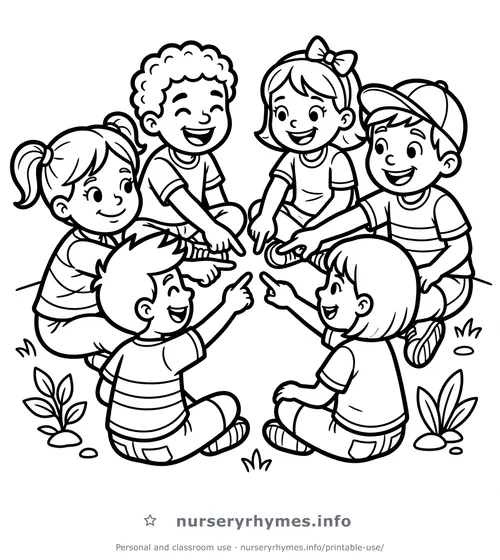
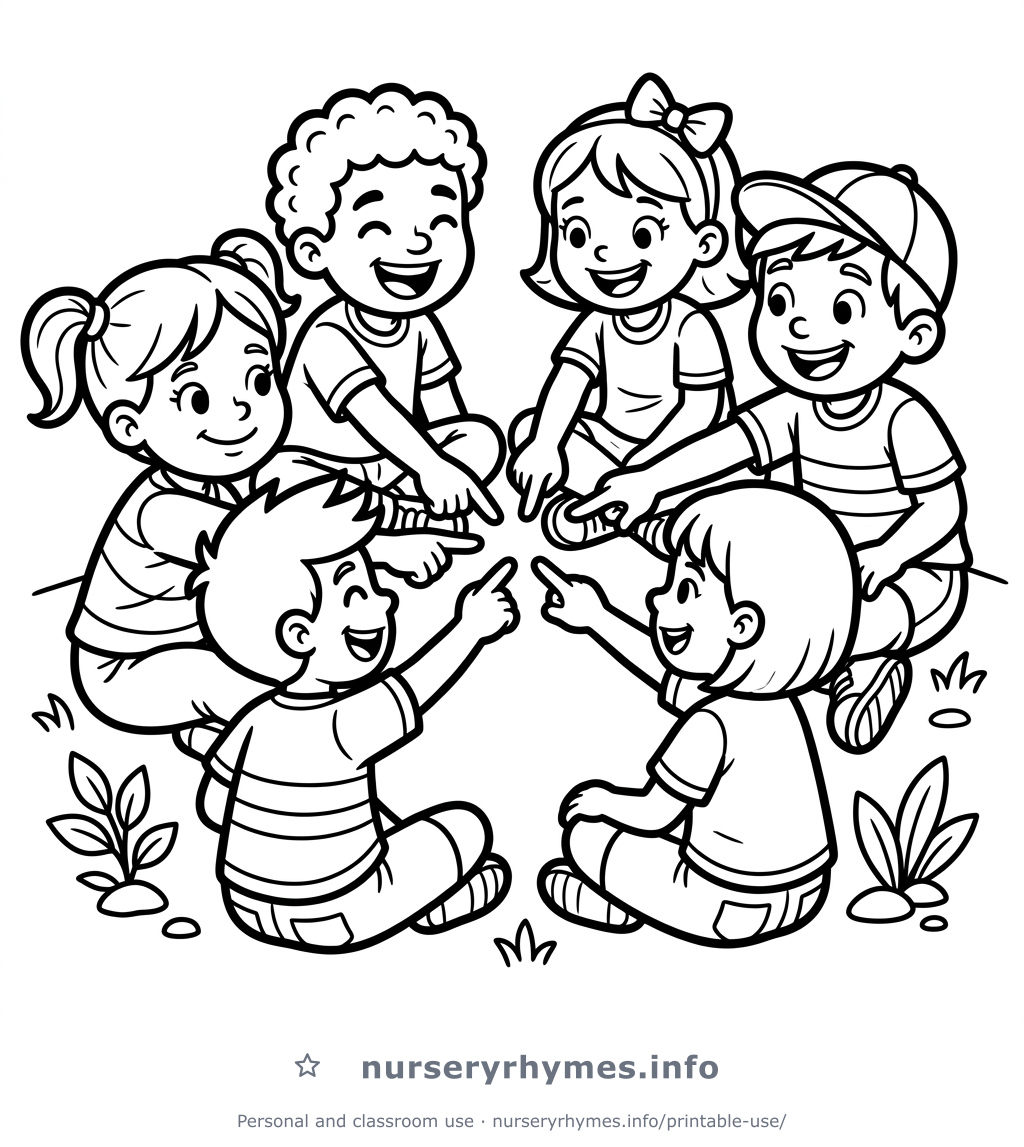
Print this Akkad Bakkad Bambe Bo coloring sheet for free and let little ones bring it to life with crayons or pencils.
Full-resolution PNG · Fits the paper size selected in your print dialog · Personal and classroom use
Lyrics from nurseryrhymes.info