
I Had a Little Hen
 1744
1744  England
 Lyrics
She washed me the dishes and kept the house clean.
She went to the mill to fetch me some flour,
She brought it home in less than an hour.
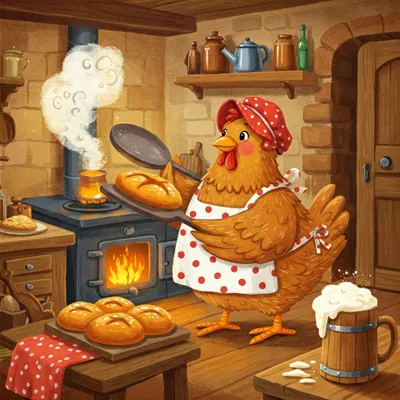
She baked me my bread, she brewed me my ale,
She sat by the fire and told many a fine tale.
History and Meaning
"I Had a Little Hen" is a traditional English nursery rhyme that first appeared in "Tommy Thumb's Pretty Song Book," one of the earliest known collections of nursery rhymes published in England.
Early Publication History
A version of the rhyme was published in 1784, and it can be found in James Orchard Halliwell's 1845 collection, "The Nursery Rhymes of England." Some sources describe it as a "north of England version of a very common nursery rhyme," suggesting regional variations existed.
The Remarkable Hen
The rhyme portrays a hen as a remarkably helpful and versatile creature, capable of performing household chores that go far beyond laying eggs:
- Washing dishes
- Cleaning the house
- Fetching flour
- Baking bread
- Brewing ale
- Telling tales
This fantastical depiction of a domestic hen performing human tasks gave the rhyme its charm and entertainment value for young children.
Possible Scottish Origins
The term "Little Hen" is a Scottish term of endearment, sometimes used as an affectionate nickname for a child. This linguistic clue hints at a potential Scottish origin for the rhyme, or at least a Scottish influence on its development.
Connection to Medieval Wool Trade
Some scholars have suggested the rhyme's origins may be linked to a wool tax imposed on farmers in medieval England, though this connection is often lost in modern interpretations of what appears to be a simple, whimsical children's verse.
Related Rhymes
"I Had a Little Hen" is sometimes confused with or compared to "Hickety Pickety, My Black Hen," another traditional rhyme featuring a hen. While both rhymes celebrate hens, they have distinct origins and lyrical content. "Hickety Pickety" dates to the 18th century and focuses on a hen that lays eggs for gentlemen, serving primarily as a playful rhythmic chant or counting rhyme.
Educational Value
The rhyme introduces young children to:
- Farm animals and their characteristics
- Household tasks and domestic life
- Rhythmic language and rhyming patterns
- Imaginative storytelling through anthropomorphized animals