
Im Shuí Im Luí
 Ireland
 Irish Nursery Rhyme
Original Lyrics
Im shuí 's im luí 's im éirí go mall
Im shuí 's im luí 's im éirí arís
Nach mé an páiste maith atá anseo inniu
Ní thiteann mo leabhar, ní dhéanaim torann
Ní labhraím os ard nuair a bhíonn múinteoir ann
Éistim go maith le gach rud dá dheir sí
Nach mé an páiste maith atá anseo inniu
Im shuí go díreach mar mhac an rí
Im seasamh chomh dlúth le crann darach
Is nuair a thagann am luí
Luím síos go ciúin sa leaba
English Translation
Sitting and lying and rising up slowly
Sitting and lying and rising up again
Aren't I the good child who is here today
My book doesn't fall, I don't make noise
I don't speak loudly when the teacher is there
I listen well to everything she says
Aren't I the good child who is here today
Sitting up straight like the king's son
Standing as close as an oak tree
And when bedtime comes
I lie down quietly in the bed
Translation Notes
Grammar Notes
Prepositional Pronouns with Verbal Nouns Irish uses a distinctive construction that doesn't exist in English: - i mo (in my) + verbal noun = describing a state or ongoing action - i mo shuí = in my sitting = sitting - i mo chodladh = in my sleeping = asleep - i mo sheasamh = in my standing = standing
The preposition i (in) combines with possessive mo (my) to form im or i mo, and the following verbal noun is lenited (softened by adding 'h').
The Particle "go" for Adverbs Irish forms adverbs by placing go before adjectives: - bog (soft) → go bog (softly) - maith (good) → go maith (well) - mall (slow) → go mall (slowly) - deas (nice) → go deas (nicely) - ciúin (quiet) → go ciúin (quietly)
Lenition After Possessives The possessive pronoun mo (my) causes lenition: - suí (sitting) → mo shuí (my sitting) - seasamh (standing) → mo sheasamh (my standing)
Vocabulary
Im shuí = Sitting (literally "in my sitting") Im luí = Lying down (literally "in my lying") Im sheasamh = Standing (literally "in my standing") Im éirí = Rising, getting up Go bog = Softly, gently Go mall = Slowly Go ciúin = Quietly Go tapa = Quickly Go deas = Nicely An páiste = The child Páiste maith = Good child Múinteoir = Teacher Scoil = School Naíonra = Irish-language preschool Gaelscoil = Irish-language primary school Rang = Class, classroom Éist = Listen Suí síos = Sit down Seas suas = Stand up Luigh síos = Lie down Scoileanna scairte = Hedge schools (historical clandestine Irish schools)
History and Meaning
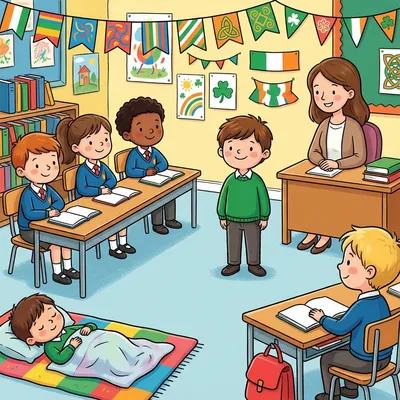
"I'm Shuí, I'm Luí" (Sitting, Lying) is a traditional Irish children's action song widely used in naíonraí (Irish-language preschools) and Gaelscoileanna (Irish-language schools) to teach young children proper behavior, body awareness, and the Irish language through movement and music. The song belongs to a rich pedagogical tradition that recognizes how young children learn best: through multisensory experiences combining physical movement, repetition, and play.
Origins
"I'm Shuí, I'm Luí" emerged from Ireland's tradition of educational action songs designed specifically for language learning and classroom management. While the exact author and date of composition are unknown, the song reflects educational practices that have been part of Irish-language instruction for generations, particularly in Gaeltacht regions where Irish is the community's primary language.
The song's pedagogical approach aligns perfectly with modern understanding of early childhood education. Children perform physical actions as they sing—sitting up straight (im shuí), lying down (im luí), standing (im seasamh), moving softly (go bog), slowly (go mall)—making the learning experience multisensory, kinesthetic, and highly memorable. This embodied learning approach ensures that Irish vocabulary is associated not just with abstract concepts but with physical experiences, creating stronger neural connections and deeper comprehension.
The Irish education system has a complex and often painful history. During British rule, especially after the Penal Laws of the 17th and 18th centuries, Irish-language education was suppressed. "Hedge schools" (scoileanna scairte) operated secretly in fields, barns, and hidden locations to teach Irish children their language, history, mathematics, and culture despite official prohibition. During these difficult centuries, even simple teaching songs played crucial roles in preserving the Irish language when it was under existential threat.
The modern Gaelscoil movement, which began in the 1970s with the establishment of Irish-immersion schools outside traditional Gaeltacht regions, has grown dramatically. Today, there are hundreds of Gaelscoileanna across Ireland and in Irish communities worldwide, educating tens of thousands of children through Irish. Songs like "I'm Shuí, I'm Luí" are central to creating immersive Irish-language environments for young children, where the language is not merely studied but lived.
Meaning & Interpretation
The song teaches children a series of actions and movements while reinforcing behavioral expectations for classroom settings. The typical sequence includes:
- Im shuí (sitting) - proper seated posture
- Im luí (lying down) - rest position
- Im sheasamh (standing) - upright posture
- Go bog (softly, gently) - controlled movement
- Go mall (slowly) - deliberate, careful action
- An páiste maith (the good child) - behavioral ideal
The emphasis on being a "páiste maith" (good child) reflects traditional Irish values of respect for teachers, quietness in appropriate contexts, and obedience to authority. While these values may seem strict by contemporary standards, they were fundamental to Irish education, particularly during periods when Irish-language schooling had to be conducted discreetly or against official policy. Discipline and quiet attention were not merely pedagogical preferences but survival mechanisms for communities trying to preserve their language and culture under suppression.
The song's focus on controlled, deliberate movement (go bog, go mall) teaches children body awareness, self-regulation, and the ability to modulate their energy—essential skills for successful group learning environments. By making these expectations into a song, teachers transform potentially tedious behavioral instructions into an engaging, memorable activity that children enjoy.
Cultural Significance
"I'm Shuí, I'm Luí" represents the revival and flourishing of Irish-language education after centuries of decline. The song teaches not just language but cultural values, connecting modern Irish children to generations of Irish-speaking predecessors. Every time children sing this song, they participate in an unbroken tradition of Irish-language instruction that survived persecution, famine, emigration, and cultural suppression.
The song also demonstrates the resilience and adaptability of Irish culture. Rather than viewing the language as merely an academic subject, Irish-language education uses songs, games, stories, and physical activity to create environments where children acquire Irish naturally, as a living language of daily interaction, play, and learning.
Educational Value
The song offers multiple developmental and educational benefits:
- Language acquisition: Vocabulary for actions, adverbs, and body parts acquired through physical experience
- Body awareness: Understanding different postures and positions
- Self-regulation: Learning to control movement and energy levels
- Following instructions: Responding appropriately to verbal cues
- Classroom management: Internalizing behavioral expectations through positive reinforcement
- Cultural connection: Participating in Irish-language tradition and community
- Grammatical structures: Exposure to unique Irish constructions (prepositional pronouns with verbal nouns)