

Itsy Bitsy Spider
 1910
1910  USA
USA Lyrics
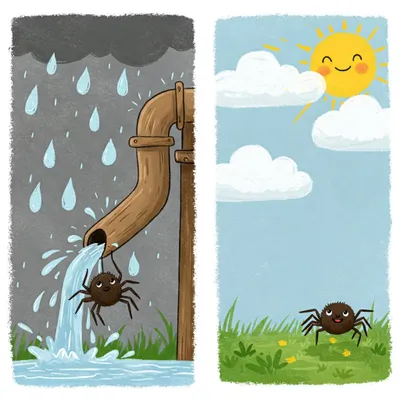
Down came the rain
And washed the spider out.
Out came the sunshine
And dried up all the rain
And itsy bitsy spider climbed up the spout again.
History and Meaning
"Itsy Bitsy Spider" (also known as "Incy Wincy Spider" in the United Kingdom and Australia) is a traditional English nursery rhyme and fingerplay song that narrates a spider's persistent efforts to climb a waterspout despite being washed away by rain.
First Publication
While the precise origin of the song is unknown, a version was first published in 1910 in Arthur Walbridge North's travelogue, "Camp and Camino in Lower California." This early rendition was referred to as "Spider Song" and featured more adult lyrics than the version known today. It was shared among workers for morale during expeditions, and in this version, the spider sometimes climbed a web rather than a waterspout.
Evolution to Children's Song
The modern, child-friendly version evolved by the mid-20th century. Composer Ruth Crawford Seeger included it as "Eency Weency Spider" in her 1948 collection "American Folk Songs for Children," complete with musical notation. This publication helped standardize the familiar lyrics about climbing a waterspout, being washed out by rain, and climbing again when the sun appears.
The Hand Gestures
The practice of performing the song with distinctive hand gestures was documented in children's folklore studies by the late 1940s. These actions include:
- The spider climbing: Touching opposite thumbs to fingers alternately in an upward motion
- The rain: Wiggling fingers downward to simulate falling rain
- The sun: Making a large circle with arms
- Climbing again: Repeating the original climbing motion
These gestures make the song an excellent tool for developing fine motor skills in young children.
Regional Variations
The song is known by different names in different English-speaking countries:
- "Itsy Bitsy Spider": Common in North America
- "Incy Wincy Spider": Preferred in the United Kingdom and Australia
- "Eency Weency Spider": An older American variant
Themes of Resilience
Despite some folklore suggesting darker origins or symbolic meanings (such as allegories for class struggle or alcoholism), there is no verified historical evidence to support these interpretations. At its core, the song is a simple, uplifting ditty about resilience and perseverance—the spider never gives up, no matter how many times it's washed down. This message of determination makes it a valuable teaching tool for young children.
Cultural Impact
The song remains one of the most popular fingerplay songs for young children worldwide. Its combination of simple melody, engaging hand movements, and positive message has ensured its place in nurseries, preschools, and homes for over a century.