

Little Boy Blue
 1744
1744  England
 Lyrics
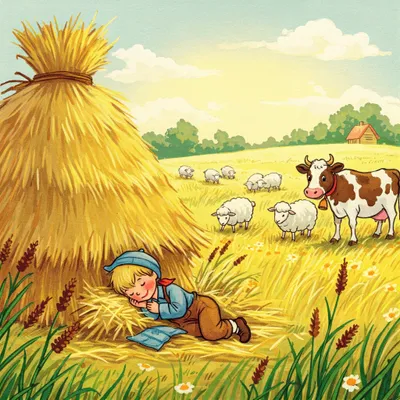
The sheep's in the meadow, the cow's in the corn.
Where is that boy who looks after the sheep?
He's under a haystack, fast asleep.
Will you wake him? Oh no, not I,
For if I do, he'll surely cry.
History and Meaning
"Little Boy Blue" is a traditional English nursery rhyme that was first published around 1744 in "Tommy Thumb's Pretty Song Book" by Mary Cooper, though its origins likely predate this publication by many years.
The Rhyme's Tale
The rhyme tells the story of a young shepherd boy who has fallen asleep under a haystack while his sheep have wandered into the meadow and his cow has strayed into the corn. When asked if they should wake him, the narrator suggests leaving him to sleep, fearing he will cry.
The Cardinal Wolsey Theory
One popular theory connects the rhyme to Cardinal Thomas Wolsey (c. 1475–1530), the powerful Tudor statesman who served King Henry VIII. According to this interpretation, "Boy Blue" alludes to Wolsey's humble origins—his father was a butcher and wool trader in Ipswich. The theory suggests the rhyme satirizes Wolsey's perceived neglect of public duties in favor of personal gain.
However, renowned nursery rhyme scholars Iona and Peter Opie rejected this historical connection, suggesting it was likely a later invention.
The Hayward Connection
Historian George Homans proposed that Little Boy Blue represents a "hayward"—a medieval official responsible for preventing livestock from straying into crops. The horn mentioned in the rhyme was a real tool used by haywards to warn of trespassing animals.
Darker Interpretations
Some scholars have noted that phrases like "fast asleep" in older English literature sometimes signified death, leading to speculation that the rhyme may be a "death rhyme." Haystacks could be dangerous places for children, and the refusal to wake the boy might represent an unwillingness to confront tragedy.
A Cautionary Tale
At its simplest level, the rhyme serves as a lesson about responsibility and the consequences of neglecting one's duties. It has been used for centuries to teach children about pastoral life and the importance of staying alert to one's responsibilities.
Shakespeare Connection
Some scholars have noted that William Shakespeare's "King Lear" (circa 1606) contains an allusion to a sleeping shepherd boy, suggesting that some version of the rhyme may have existed even earlier than the 18th century publication.