

London's Burning


Lyrics
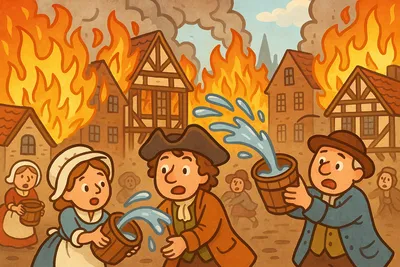
London's burning, London's burning.Fetch the engines, fetch the engines.Fire fire, Fire Fire!Pour on water, pour on water.
London's burning, London's burning.Fetch the engines, fetch the engines.Fire fire, Fire Fire!Pour on water, pour on water.
London's burning, London's burning.Fetch the engines, fetch the engines.Fire fire, Fire Fire!Pour on water, pour on water.
History and Meaning
Everyone links "London's Burning" to the Great Fire of 1666, but the round is older than the fire it seems to describe. An almost identical version, about Scotland burning, was written down in 1580. It is sung in overlapping parts, the voices piling up like the panic of a real blaze.
How does the Fire of London relate to the song?
The Great Fire of London began on September 2, 1666, in a bakery on Pudding Lane and burned for four days, destroying much of medieval London. The fire consumed:
- 13,200 houses
- 87 churches
- St. Paul's Cathedral
- Most of the buildings of the City of London
Despite the massive destruction of property, the recorded death toll was very low, though the true number may never be known. While popular tradition links the song to this catastrophe, historical evidence shows the melody and concept predate the fire.
What is the message and lyrics of London's Burning?
The lyrics are all urgency and chaos:
"London's burning, London's burning, Fetch the engines, fetch the engines, Fire fire! Fire fire! Pour on water, pour on water."
The references to "engines" refers to the primitive fire engines of the era, which were hand-operated pumps that required teams of men to operate. The call to "pour on water" reflects the desperate attempts to fight the blaze.
Why is London's Burning sung as a round?
London's Burning is one of the most popular rounds for group singing. Its simple four-part structure makes it ideal for:
- Teaching children about rounds and harmony
- Group singing activities in schools
- Campfire songs
- Introduction to basic musical concepts
Each group starts at a different time, creating overlapping harmonies that grow increasingly complex and exciting, perhaps mirroring the chaos of the fire itself.
What are the historical questions about the song's origins?
While the song is traditionally associated with the 1666 fire, scholars have established that its roots are older. A similar round with the lyrics "Scotland, it burneth, look out, look out" was recorded in the Lant Manuscript in 1580. A version was later printed in 1609 in Thomas Ravenscroft's collection Pammelia, nearly sixty years before the Great Fire of London.
The word "Scotland" was likely changed to "London" in later years, and the reference to "engines" was added as firefighting technology evolved, helping to bind the song permanently to the 1666 event in popular memory.
What is the educational value of London's Burning?
The song serves as a memorable introduction to:
- The history of the Great Fire of London
- How fires were fought in earlier eras
- Musical concepts like rounds and harmony
- British history and heritage
What is the cultural impact of the song?
London's Burning remains popular in British schools and has spread internationally as one of the most well-known rounds in the English language. It provides a simple yet powerful way to remember one of the most significant events in London's long history.
Music Video
If the player is unavailable, watch this video on YouTube.
Lyrics from nurseryrhymes.info