
Miss Polly Had a Dolly
 Early 20th Century
  UK/ USA
 Lyrics
So she called for the doctor to come quick, quick, quick.
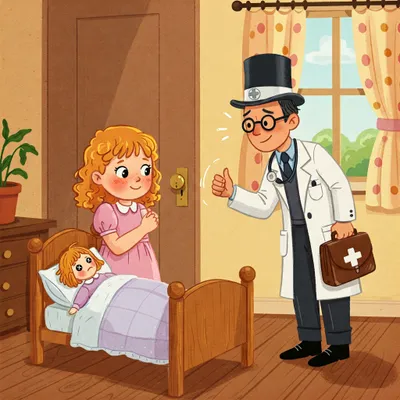
The doctor came with his bag and his hat,
And he knocked on the door with a rat-a-tat-tat.
He looked at the dolly and he shook his head,
And he said "Miss Polly, put her straight to bed!"
He wrote on a paper for a pill, pill, pill,
"I'll be back in the morning with the bill, bill, bill."
History and Meaning
"Miss Polly Had a Dolly" is a popular English-language nursery rhyme and children's action song with origins that remain somewhat unclear, though it has been traced to Scottish folk tradition.
Origins
While some sources suggest the rhyme originated in England during the 18th century, possibly conveying political satire or hidden messages, more reliable evidence places its origins in the late 19th or early 20th century. The song is noted to be of Scottish origin and has a Roud Folk Song Index number of 16289.
The earliest known formal publication was in 1986 by Maureen Sinclair in Glasgow, Scotland, though the song was almost certainly passed down orally for generations before being recorded in print.
The Story
The rhyme tells a simple but engaging story of a child (Miss Polly) caring for her sick dolly:
- The dolly becomes sick
- Miss Polly phones for the doctor to come quickly
- The doctor arrives with his bag and hat
- He examines the dolly and prescribes rest and pills
- The doctor promises to return in the morning
An Action Song
"Miss Polly Had a Dolly" is frequently used as an action song in classrooms and nurseries. Children perform movements corresponding to the lyrics:
- Rocking a doll when the dolly is sick
- Pretending to use a telephone
- Knocking ("rat-a-tat-tat") when the doctor arrives
- Shaking their heads like the doctor
- Pretending to write a prescription
Educational Themes
The rhyme teaches children about:
- Empathy and compassion: Caring for someone who is unwell
- Healthcare: Introducing concepts of doctors, medicine, and treatment
- Nurturing: The value of looking after others
- Role-playing: Practicing adult scenarios through play
- Telephone use: A practical life skill woven into the narrative
Variations
Like many traditional nursery rhymes, "Miss Polly Had a Dolly" exists in various versions with slightly different lyrics. Some versions have the doctor prescribe different remedies, or include additional verses about the dolly's recovery.
Enduring Popularity
The song remains popular in preschools and early childhood settings worldwide. Its combination of a relatable narrative, simple melody, and opportunities for dramatic play make it an ideal tool for engaging young children while teaching important social concepts.